Monday, April 11, 2016

Heydrich: The Hangman


Reinhard Heydrich was in many ways the personification of 20th century totalitarianism. The security chief of the Third Reich, he was more responsible than anyone else for creating the police state that spread its tentacles throughout German society and into Nazi-occupied Europe. More than anyone other than his chief Heinrich Himmler and the Führer, he was the chief architect of the Holocaust. Contemporaries described him as “wolf-like” and “demonic”, a man of sinister intellect who overshadowed Himmler (Himmlers Hirn heisst Heydrich, they said – “Himmler’s brain is called Heydrich”). He appeared to many of those who worked with him as completely devoid of human warmth – the German historian Joachim Fest wrote in an important essay on Heydrich that the man radiated aLuciferian coldness.” His biographer Robert Gerwarth makes the careful and important point in his book Hitler’s Hangman that many of these men had reason to paint him in as brutal colors as possible – some, though not all, of the descriptions came after the war, when these men of the SS and SD were trying to distance themselves desperately from the man who had become known to history  as The Butcher of Prague and The Hangman. Nonetheless, there must have been a core of truth to it. He was legitimately feared in his lifetime by other Nazis – he had dirt on them, and had shown throughout his loathsome career that he was not afraid to use this tactic to end careers, and lives. He had proven throughout the 1930s that he was willing to walk over anyone and everyone’s corpse to attain power.


Heydrich’s name is, of course, well known to anyone who is well-read (or not even that well-read) in the history of Nazi Germany and the Holocaust. But at the same time, he is ultimately a shadowy figure. Center stage is taken by Hitler, Himmler, or Heydrich's subordinate Eichmann, who has become one of the major symbols of Nazi evil not due to any rank held, but to his responsibility for rounding up and dispatching millions of Jews to their deaths. Despite the importance and centrality of Heydrich’s role, he appears somehow always off screen, a mysterious phantom just tantalizingly out of reach of the reader. I can think of no other prominent Nazi leader save Bormann of whom this is true. But it was Heydrich who drew up the policies that Eichmann implemented. He ordered ghettoization, the Jewish Councils (Judenräte), deportations, the creation and operations of the mobile killing units (Einsatzgruppen), the marking of Germany’s Jews with the yellow star, and, the act for which he is perhaps most notorious, chaired the Wannsee Conference, where the Final Solution was streamlined (I covered this in my last post). But somehow he is always just off-stage.

He stares at us through narrow eyes in the official photographs, somehow blasting us with that “Luciferian coldness” through the page (or computer screen) and over the distance of seven decades. I remember watching a scene in an old History Channel documentary in which Heydrich is walking out of a building through a phalanx of onlookers. He walks right up to the camera and stares into it with such an intense and predatory look before turning away that I was jolted from my seat, my heart jumping up to my throat. I had recorded the program and rewound it back a couple of seconds. Sure enough, even though I knew what was coming, every time Heydrich fixed me with that glance (and I did feel that he was looking at me, and even through me), my body gave the same biological response. In watching this scene, my body was instinctively reacting not to a man, but to a wild animal. When I saw the same couple of seconds being played on another documentary that I was watching recently, the same thing happened – a fight or flight reflex kicked in.

Who was this man? He was born in Halle an der Saale, northwest of Leipzig in Saxony-Anhalt, on March 7, 1904. He was too young to fight in the First World War, but the reverberations from that war certainly shaped his outlook. His childhood was filled with revolutionary violence from the radical left, and their violent suppression by the radical right, which certainly shaped his later political views. His father, a composer, owned and operated a conservatory. As Heydrich’s biographer Gerwarth explains, Heydrich’s father has been unfairly untarnished as a third-rate composer in hindsight not because of his actual musical talents or lack thereof, but because of the nefarious reputation of his son. Heydrich himself was from a young child a talented musician, playing violin concerts well into adulthood, supposedly playing Haydn while sentimentally weeping. This from a man who ordered the deaths of millions with a heart of granite (or “of iron”, as Hitler said admiringly at Heydrich’s funeral in June 1942).

Heydrich’s father Bruno is not unimportant because a man who felt slighted by Bruno accused him of being Jewish. This was not true. But Bruno’s stepfather was named Süss, a common Jewish surname at the time. Süss was not Bruno’s biological father, nor was he Jewish, but nonetheless rumors of Jewish blood chased Bruno (and his son Reinhard) throughout the rest of his life. Some have ascribed Heydrich’s later murderous anti-Semitism to being in reaction to this false accusation of Jewish blood; perhaps he believed he was Jewish, and in seeking relentlessly to destroy the Jews of Europe, he was in fact really seeking to extinguish the Jew in himself. As in most psychoanalytical history, this does not hold much water.

Heydrich, always fascinated with all things military and grated by the fact that he had missed out on the Great War, joined the Navy at the age of 18. There he was apparently an efficient officer although disliked by his subordinates for his arrogant attitude. In a further sign of his arrogance, he impregnated a lover and then refused to wed her; the woman’s father brought him before a court of honor, which cashiered him, not so much for the offense as for the high-handed demeanor with which he carried himself in court.

Heydrich was, in fact, already engaged at that point, to his future wife Lina von Osten, a decidedly Lady Macbeth-type figure. While Heydrich at this point was fairly apolitical (although sympathetic to the parties of the radical right), his wife was a convinced Nazi and came from a family of others of like mind. After Heydrich was dismissed from his post as an officer, he locked himself in his apartment and wept for days; this was a man who had gloried in the uniform, and what would he do now for a career? He was finished, he thought. This was, after all, the time of the Great Depression. Through her connections, his fiancée was able to set up a meeting with the head of the SS, Heinrich Himmler, who was keen on setting up a counterintelligence unit of his organization. Wrongly believing that Heydrich had been an intelligence officer in the Navy (he had in fact been a communications officer), Himmler agreed to meet with Heydrich and told the young man to demonstrate how he would organize a spy agency. Heydrich drew up a plan based upon his knowledge of spy novels and Himmler was impressed. Heydrich was hired and, drawn by the quasi-military nature of the SS and happy to have a job again (and happy to please his rabid Nazi of a wife), he accepted the position. This, born of largely if not entirely opportunistic motives, was to be the watershed moment of what would become an almost unimaginably murderous career.

Heydrich worked around the clock, arriving at his desk very early and only leaving very late, on an exceedingly modest salary. Nonetheless, he seems to have found his passion. The SS intelligence service that he created from scratch became known as the Sicherheitsdienst (Security Service, or SD). Heydrich set about drawing up index cards of anyone and everyone, enemies and even friends, gathering dirt on individuals to use later in the pursuit of power. When the Nazis came to power in 1933, Heydrich deployed these index cards to round up leftist political opponents, who were thrown into concentration camps such as Dachau. In 1934, he was a crucial player during the Night of the Long Knives, when the SS murdered key leaders of the SA to rid Hitler of a potentially dangerous enemy to his right. Heydrich was instrumental in drawing up the death lists in this purge. Later, he and Himmler were able to take over the Bavarian police and, in April 1934, the Gestapo, which beforehand had only operated in Prussia (albeit the largest German state) under the auspices of Hitler’s deputy Hermann Göring. In 1936, Himmler became the chief of the police in every German state and with him came Heydrich, who took operational control. He used his power as Gestapo chief to pre-emptively arrest anyone who might be a threat to the Nazis, or anyone he might not like. He incarcerated such individuals in concentration camps or even had them killed. While Heydrich had almost complete sway over individuals outside of the concentration camp gates, that is where his authority stopped – this hindrance later led Heydrich to clash with Theodor Eicke, first commandant of Dachau and then head of the entire concentration camp system.

After the Anschluss of March 1938, in which Germany annexed Austria, Heydrich oversaw the forced emigration of Austrian Jews, executed through the office of the aforementioned Eichmann. At this point, Jews were not being forcibly deported to ghettos or camps, but rather abroad – anywhere, just out of the Nazis’ hair. This was to be Eichmann’s grooming before he deployed his considerable talents to transporting the Jews to the gas chambers. Heydrich was also instrumental in the notorious pogrom of Kristallnacht, which occurred throughout the Reich (including Austria) in November 1938. Heydrich ordered that any fires raging in synagogues or Jewish shops or homes should not be stopped unless if the flames endangered “Aryan” dwellings or places of business. Jewish homes and shops could be destroyed, but not looted (we don’t want to look like hooligans, after all!). As long as everything was “proper,” the police were not to interfere with the pogrom. In the end, nearly 100 Jews were murdered, hundreds of synagogues and thousands of Jewish-owned shops destroyed, and 30,000 Jews sent to concentration camps. In January 1939, Hermann Göring charged Heydrich with organizing a solution to the Jewish "question" within the Reich. 

In order to begin what became the Second World War, Hitler needed a pretext, even a flimsy one. Heydrich carried out a plan whereby Polish-speaking SS men “captured” a German radio station on the German-Polish border. The bodies of “Poles” were provided by dead concentration camp prisoners. Using this staged incident as well as the supposed depredations of Poles on ethnic Germans within Poland (some of which was factual), Hitler launched his armies on September 1, 1939, beginning the Second World War. Following the army into  Poland were SS and police units organized by Heydrich to fulfill the “cleansing” of Poland and the extermination of its intelligentsia, including priests, lawyers, academics, journalists, and others. The purpose was to destroy the Polish nation. Heydrich had delicately come to an arrangement with the army such that these Einsatzgruppen technically worked under military auspices but in reality took their orders directly from him, Heydrich. After the conquest of Poland and the handover of control from military to civilian authorities, Heydrich, acting on orders from Hitler and Himmler and operating through Adolf Eichmann, began the diabolical re-engineering of Poland. Poles and Jews were deported from western Polish territory annexed to Germany to make room for ethnic Germans from the Baltic States and Ukraine. German-looking Polish children were stolen from their families and taken to Germany. Hundreds of thousands of people were affected by this.

Four weeks after the invasion of Poland, the Criminal Police was merged with the Security Police (the Gestapo and the SD) to form the Reichssicherheitshauptamt (Reich Security Main Office, or RSHA), which was placed under Heydrich’s control, effectively placing him at the center of the National Socialist spider web. In Poland, Heydrich and his underlings, especially Eichmann, set about trying to “solve” the “Jewish question.” Poland was the heart of European Jewry. Heydrich ordered that the Jews be concentrated in ghettos in major cities near rail lines: ghettos were duly set up in major cities such as Warsaw, Kraków, and Łódź. At first, he had Eichmann toy with various places to dump these Jews: first near Lublin, in the eastern part of Nazi-occupied Poland, and then Madagascar, the island off of Africa in the Indian Ocean. Both schemes came to naught. But in the meantime, the Jews had been ghettoized, isolated from the rest of society, and were forced to live on top of one another, with little food and much disease. No “Final Solution” was yet in the offing, and the Jews were forced to stay in these confined spaces. Later, accommodations were made for them in the yawning maws of Auschwitz-Birkenau, Chełmno, Bełżec, Sobibór, and Treblinka.

In the run-up to the invasion of the Soviet Union in the summer of 1941, Heydrich set about organizing new Einsatzgruppen, who would be much more murderous than their forebears who had operated in Poland. They were ordered to murder all Comintern members, medium- and senior-ranking Communist party and state officials, and Jews in party and government posts. Because of the deliberate conflation of “Jew” and “Communist” in Nazi propaganda, this meant that these mobile killing units were essentially given carte blanche to kill any adult Jewish male. The Einsatzgruppen also made it their business to prod local anti-Semites to murder Jews in frantic pogroms, such as seen in Kaunas and Lviv, but to keep German “fingerprints” unseen so as to make the pogroms seem purely local in origin. Later on, the Einsatzgruppen’s brief extended beyond adult Jewish males: beginning particularly in August 1941, Jewish women and children were killed as well. In late August, 23,600 were murdered in Kamenets Podolsky and, in September, 33,771 in the ravine of Babi Yar outside of Kiev. These were only the most notorious of the massacres. Heydrich was the primary author of all of this and when he visited his commanders in the field, he urged more radical measures and a higher body count.

Heydrich was in general one of the radical prods of the regime, particularly when it came to the Jews. In August 1941, both he and another fanatic, Propaganda Minister Joseph Goebbels, twisted Hitler’s arm to first mark the Jews of the Reich and then to deport them. Hitler was hesitant. He believed, as did so many Nazis, that Germany had never militarily lost the First World War; rather, it had only lost because of the disintegration of the home front, which the Nazis naturally blamed on Jews and socialists. Hitler was terrified of rocking the boat at this juncture and refused to either mark or deport the Jews. A month later, for whatever reason, he changed his mind – Heydrich was successful in introducing the yellow star to the Reich Jews (which he had first proposed at a meeting shortly after the Kristallnacht pogrom three years earlier). Furthermore, the Jews were deported out of the Reich. Jews in places like Minsk and Riga were shot to make room for the Reich Jews; beginning in December 1941, Jews from the Łódź Ghetto were sent to Chełmno to make room for them and, beginning in spring 1942, the Jews of the Lublin district to Bełżec and Sobibór.

In addition to his responsibilities as the head of the RSHA, Heydrich was named the Acting Reichsprotektor of Bohemia and Moravia (essentially the present-day Czech Republic) in September 1941 and was put up in Prague Castle.  This gave him direct access to Hitler, whereas previously he had to go through Himmler. He announced that his goal was to "Germanize this Czech garbage" and set about crushing the Czech resistance through the adept use of carrots and sticks. The Czechs became quiescent and Heydrich, as was his wont, became exceedingly arrogant and careless. This would cost him his life in June 1942.

In November 1941, Heydrich had Eichmann send out invitations to a conference in the affluent suburb of Berlin, Wannsee. After a delay, the meeting convened on January 20, 1942. Its purpose was, essentially, to concretize Heydrich and the SS’ role as the spearhead against the Jews. Other ministries were to grasp the importance of the project and get in line. In this, the meeting was largely successful. During the meeting, Heydrich said that Europe would be swept east to west of Jews, who would be forced to work in labor columns building roads for the German armies until they were dead. Anyone who survived this murderous work would be "dealt with accordingly": in other words, killed. Those incapable of working were implicitly to be murdered. According to Eichmann, the methods of killing Jews were intimately discussed at the meeting, scarcely 90 minutes long, at which the participants sipped brandy. It was determined that 11 million Jews – in countries under Nazi control, under the control of Germany’s allies, or in neutral/hostile countries – were to be subjected to the Final Solution. While none of the death camps (outside of the gas van station at Chełmno) were yet in operation, it was menacingly clear what was meant by this. After Heydrich was assassinated in Prague, Aktion Reinhard, comprising the camps of Bełżec, Sobibór, and Treblinka and administered out of Lublin, was named in his “honor.” These camps consumed some 1.7 million victims, predominantly Polish Jews.

As Reichsprotektor of Bohemia and Moravia, Heydrich had come to acquire a certain sense of international notoriety, appearing on the cover of TIME Magazine in caricature form surrounded by nooses (due to his nickname of The Hangman). In addition, the Czech government-in-exile was feeling desperate to prove its worth to the Allies so that, after the defeat of the Nazis, it would get a proper seat at the table and its country would be able to win its independence (alas, it was to fall under crushing Communist rule until 1989). A Czech and Slovak team was trained by British special forces with the specific purpose of assassinating the ghoul ruling from Prague Castle. The team was later parachuted into Bohemia. After observing Heydrich and discovering his patterns, they attacked on May 27, 1942, firing guns and throwing grenades at Heydrich’s vehicle as he commuted to work. Like a horror movie villain, Heydrich jumped out of the car and chased his assassins, firing his pistol until he collapsed in pain. After a week of agony, Heydrich expired in a Prague hospital on June 4.

Hitler and Himmler spoke at his funeral, singing his praises as the ideal National Socialist, the “man with the iron heart” who could hardly be replaced. Hitler fumed at Heydrich’s idiocy and arrogance, driving through the streets of Prague with his car’s top down. He threatened to unleash hell in response, and he did. The Nazis got (false) information that a village outside of Prague, called Lidice, had harbored Heydrich’s killers. The entire male population of Lidice above the age of 16 was lined up and shot; the women were sent to concentration camps; and children, if of “suitable” racial appearance, were sent to German families or, if not, gassed at Chełmno. The village itself was destroyed: its buildings were demolished, and then the ruins detonated; the Nazis even salted the earth. A similar fate met another village, Lezaky. Thousands of people were executed to sate the Nazi bloodlust which was, in fact, insatiable.

Heydrich’s name stands alongside those of Hitler and Himmler as the most dastardly of the Nazi regime. Given his buildup of the German security state and his engineering of the Holocaust, his name should stand in the ring of dishonor of the 20th century, alongside not only Hitler and Himmler, but Stalin, Beria, and Mao Zedong. While students of the period are acquainted with his name, I have found all too often that he is not widely known by those with only a casual knowledge. His subordinate Eichmann, because of his sensational capture and trial in Jerusalem, is far better known. But the truth is that the Third Reich and its predatory policies are simply not understandable without looking at this man. He was, in a way, a microcosm of National Socialism itself: fanatical, utterly ruthless, and driven by a furious intensity toward power and domination. He loathed the Jews, and he murdered them in the millions. He despised the Catholic Church, in which he was baptized as a child, and hoped to one day bring about its ruin. He had supreme contempt for mankind, and so he terrorized, brutalized, and imprisoned hundreds of thousands, and brought misery to an entire continent. Indeed, for such a man, there is no more fitting epitaph than Aktion Reinhard, the program to exterminate Polish Jewry, and the destruction of Lidice. In the final analysis, Heydrich’s life’s work was a mountain of ashes and bones. His name and memory should send a chill down the spine of the entire civilized world.

Wednesday, March 23, 2016

The Significance of the Wannsee Conference

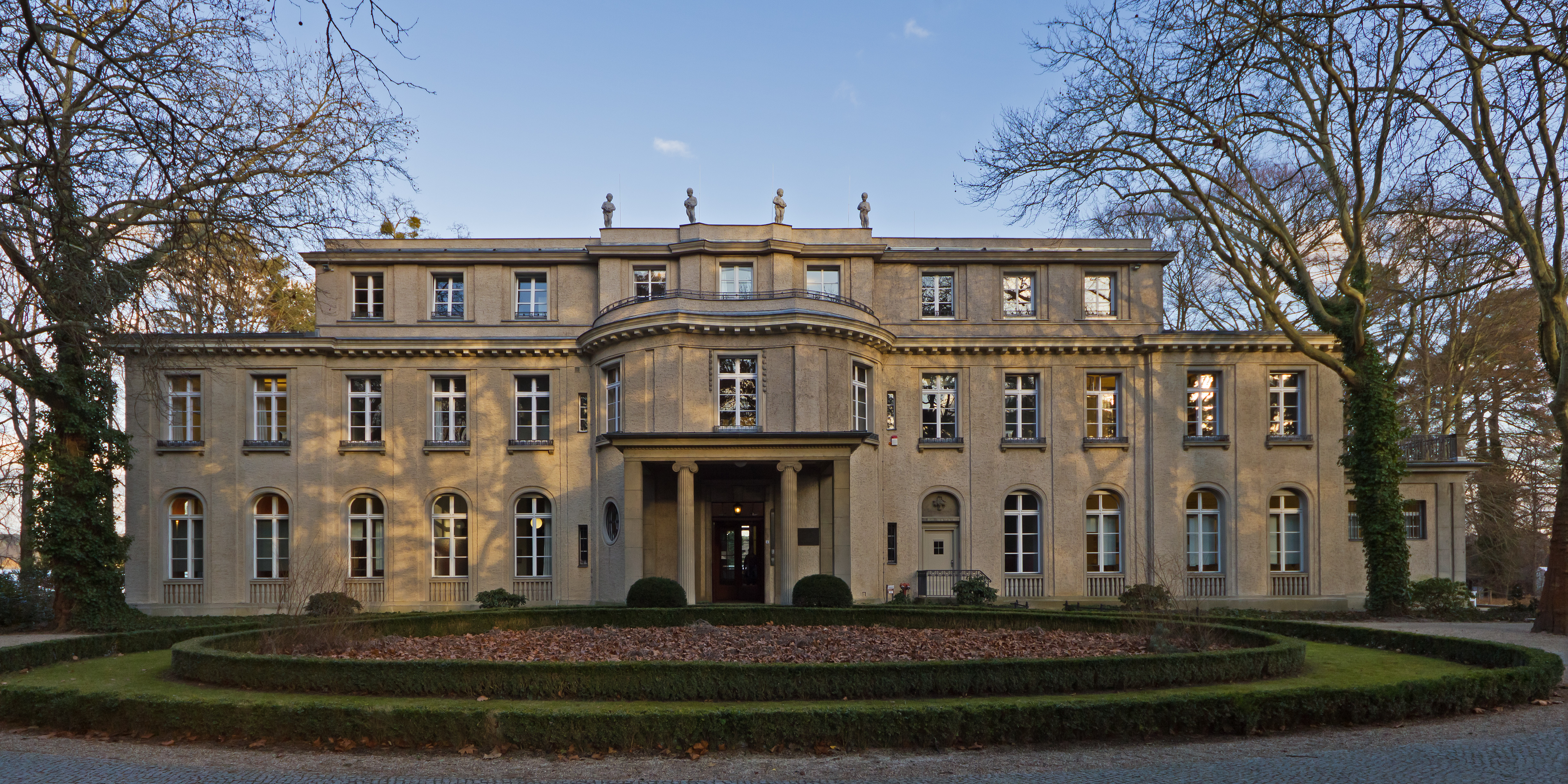
The house where the Wannsee Conference was held.

On January 20, 1942, 15 SS officers, Nazi party officials, and civil servants met at a villa at 56-58 Am Groβwannsee in a Berlin suburb. They were convened by Reinhard Heydrich, the head of the Reichssicherheitshauptamt (RSHA – Reich Main Security Office), which incorporated the SD (SS intelligence) and the Security Police, itself made up of the Gestapo and the Criminal Police.

Heydrich was Heinrich Himmler’s deputy who had been charged by Hitler and Hermann Göring to implement the Final Solution of the Jewish Question in the German sphere of influence. Heydrich was renowned for his ruthlessness even in the Nazi context: contemporaries called him the “blond beast,” a “young, evil god of death,” “wolf-like,” “predatory,” and “demonic.” He has gone down in history as "The Hangman" and "The Butcher of Prague." When one reads about Heydrich, the overriding theme is his singularly ferocious drive to “cleanse” Germany and then Europe of the Jews. While Nazi policy twisted and turned before settling on the comprehensive extermination of European Jewry, I highly doubt that Heydrich would have had qualms about such wanton murderousness from the very beginning.

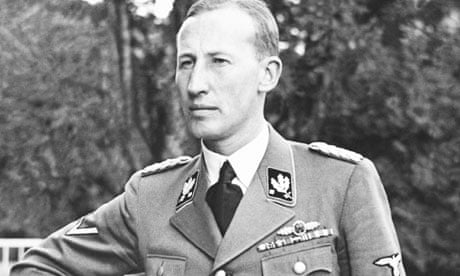
Reinhard Heydrich

The purpose of the Wannsee Conference does not appear to have been to begin the extermination program – it did not represent the culminating decision to embark on mass annihilation. Jews were already being shot in the Soviet Union – a million were murdered between the onset of the invasion in June 1941 and the end of that year. Jews were also being gassed at Chełmno in Nazi-annexed Poland and the construction of the Bełżec death camp began the previous November. Plans for gas chambers and massive crematoria were drawn up for an extermination camp outside of Mogilev in October 1941 (when these plans were later scrapped, the crematorium ovens were rerouted to Auschwitz-Birkenau). Jewish men were being systematically shot as hostages in Nazi-occupied Serbia. Rather, the purpose of the meeting was to make clear to all relevant parties that the SS was responsible for the regime’s Jewish policy.

How did it come to this? Rather than always having been envisioned by Hitler from the time he wrote Mein Kampf, if not earlier, the extermination of the Jews was not always foretold in Nazi policy. There is no historical consensus as to when, or even if, there was a discrete order by Hitler to murder the Jews. The policy before the war was to persecute and isolate the Jews by forbidding them from certain professions, the forced “Aryanization” of their businesses, strict segregationist policies, and the prohibition of intermarriage. There was certainly violence, particularly during the Anschluss in March 1938 and, most ominously, during Kristallnacht in November 1938, during which Jewish homes, shops, and synagogues were attacked, nearly 100 Jews killed, and about 30,000 thrown into concentration camps. But at this stage of the Nazi dictatorship, concentration camps, while certainly no joke, were not death sentences and prisoners could be, and were, released. The purpose of this massive violence, whose flames were fanned by Nazi Propaganda Minister Joseph Goebbels, was primarily intended not to kill the Jews, but to induce them to leave the country. At this point in time, it was Adolf Eichmann’s job, in Vienna, Prague, and then Berlin, to force the Jews out of German-controlled territory. 

When the Germans invaded Poland and took control of two million more Jews, the Nazis first planned a Jewish reservation near Lublin and then a colony in Madagascar. These would have been murderous and were clearly genocidal, but did not bear the hallmark of the later Final Solution that makes it so unique. For their inchoate Final Solution, the Nazis forced the Jews into major urban areas near rail lines, perhaps most infamously at Warsaw and Łódź. This was pursuant to a Heydrich directive from September 1939. But the back and forth among ghetto administrators and between the ghetto administrations and Berlin, and between other channels of communication, make it readily obvious that there was no master plan at this point. Hans Frank, the governor of occupied Poland, clashed repeatedly with the SS and with Nazis such as Arthur Greiser, who wanted to deport all the Jews under his control to Frank’s fiefdom, the General Government (the thrust of the Wannsee Conference was to sort out such clashes). When Frank learned of the Madagascar Plan, he was delighted and gloried in the possible deportation of Jews from his territory and ordered that ghetto construction cease. When the Madagascar Plan fell through due to the Nazis’ failure in the Battle of Britain, Frank glumly conceded to maintaining the ghettos. The Jews were shunted from towns and villages into major cities (or vice versa as in the Lublin and Kraków districts) to be deported somewhere: but where?

The Germans and their allies/co-belligerents invaded the Soviet Union on June 22, 1941. This was to be a “war of extermination” between competing worldviews; the gloves were off. As the Nazis, among others, conflated Judaism and Bolshevism, the war against the Soviet Union was also a war against the world Jewish conspiracy in which the Nazis genuinely, and fervently, believed. The invasion of the Soviet Union was therefore a watershed event in which the Nazis could gain Lebensraum, hegemony over continental Europe, and a reckoning with the Jews  (and also, as a desired strategic effect, cause a truce with the British). The East would be, in Hitler’s words, the German “Garden of Eden” – the wheat fields of Ukraine would feed the Germans, and the Slavs would either die or serve them. The Jews would be sent to some abstract “East” – there was obviously no room for them in this utopia. The Jews were to be dealt with after the war, which the Germans thought would be swift; they soon realized otherwise as their tanks sunk in the mud in the autumn and their soldiers froze on the outskirts of Moscow in the winter. 

Following the German armies into the Soviet Union were mobile killing squads created by and under the direct orders of Heydrich. As an aside, the image of the “desk killer”’ is a false one – the fanatical young intellectuals who made up the personnel of the RSHA were largely eager to put their ideology into practice by commanding these killing units. This was true of the head of RSHA Amt (Office) I, Bruno Streckenbach; the head of the Criminal Police, Arthur Nebe; and the head of Amt VII, Franz Six, a professor of sociology. Hannah Arendt’s misleading analysis of Adolf Eichmann as an unthinking desk killer, unmotivated by ideology, influenced later views of the “typical Nazi” who would send the Jews to their deaths because it was “their job.” Indeed, it was their job, but it was a job they did with relish, a job they sought to accomplish with proficiency. These mobile killing squads, and their accomplices among local populations, killed some two million Jews during the Second World War in the occupied Soviet Union in locations such as Riga, Vilnius, Kiev, Minsk, Mogilev, and Kamenets-Podolski.

After prodding from Heydrich and Goebbels, in September 1941 Hitler (who was hesitant on this point) agreed to marking German Jews with the now-infamous yellow star and deporting them to the east. In certain cases, German Jews were shot on arrival; in most cases, they were sent to the Łódź Ghetto, Lublin district, Riga, and Minsk, where they replaced the local Jews who had already been killed, either by gassing in Chełmno and Bełżec or shot. In October 1941, Heinrich Müller, the head of the Gestapo, ordered that Jews were no longer to be allowed out of German reach. Previously, that had been the aim of Nazi policy; now, the Germans wanted them close to hand. And given the convergence of circumstances that I have just outlined, at this point, the Rubicon had clearly been crossed. Due to the military circumstances alluded to above, the war was not going to end any time soon, which even Hitler realized. At some point, he came to the conclusion that it would be best to murder the Jews during the war and in areas already under Nazi control.

The Wannsee Conference was largely about bureaucratic infighting, of paramount importance in the Nazi universe. Heydrich, and by extension the SS, insisted on running point in the extermination of the Jews. Other agencies were brought to heel. The other agencies that participated in the conference included the Foreign Ministry, Ministry of the Interior, Ministry of Justice, the General Government, the Ministry for the Occupied Eastern Territories (Ostministerium), the Reich Chancellery, the Führer Chancellery, the Office of the Four-Year Plan (Göring’s economic empire), and the Race and Resettlement Main Office (tasked with reordering the racial makeup of Nazi Europe). It was essential for the SS to work with all of these agencies, and then some, to accomplish the Jews’ murder. Officials in the General Government, as discussed above, as well as the Ostministerium, had squabbled with the SS over jurisdiction of the Jews, and had jealously clung to their authority. Hermann Göring, in his capacity as overlord of Germany’s war economy, insisted that the priority should be for the Jews to work as slave laborers, and he got Frank’s back in disputes over Jewish labor in the General Government. After having proved itself over six months of having the most radical and, in their eyes, effective solution to the Jewish question, the SS had “earned” the “bona fides” to steer the ship. The rest of the agencies were reined in and, in the following months and years, followed suit.

After the conference, the Jews of Poland were obliterated in the camps of Aktion Reinhard (Bełżec, Sobibór, and Treblinka), administered from Lublin and named in “honor” of Heydrich, who was assassinated in Prague in June 1942. Further sweeps by the mobile killing squads in the spring and summer of 1942 further decimated the Jews of eastern Poland and the Soviet Union. Jews from all over Europe from the Channel Islands to Poland were murdered in Auschwitz-Birkenau, whose geographic location in the center of Nazi-occupied Europe made it perfectly suited for its task. After two years of frantic killing, the last large Jewish population was in Hungary: its members were deported to Auschwitz-Birkenau in a murderous frenzy from May to July 1944. The mass murder of the Hungarian Jews (some 400,000 were killed in the just-mentioned time frame) was Eichmann’s moment in the sun, his magnum opus.

While it is not clear when the Nazis finally had their “a-ha!” moment about murdering the Jews of Europe, the Wannsee Conference had the effect of clarifying who would be in charge, who would be murdered (the attendants argued about the merits or lack thereof of murdering German quarter- and half-Jews, a topic that was not decided and was dealt with at a subsequent, lower-level meeting), and the necessity of bureaucratic cooperation in the endeavor. It was decided that 11 million Jews, from areas under Nazi control or that of their allies, or in neutral countries, would be subject to the Final Solution. This was not parallel or subordinate to the Nazi war effort: the Jews’ destruction was a major war aim. Over a million had already been murdered by the time these men sat around the table at Wannsee – the conference simply cleared the path to a process already set in motion and already hurtling into the abyss with devastating speed.

Monday, January 4, 2016

Lublin and the Final Solution: Personal Reflections and History


Lublin Castle. Photo taken by the author. 

As I approached the countryside that surrounds Lublin, the largest city in Poland east of the Vistula, I suddenly felt like I was in “real” Poland. In the fields, I saw the controlled burning of fields and bucolic vistas of humble farmhouses, cattle, and horses. Periodically I would glance down at the book I was reading, about Poland’s interwar years, but I was unable to really concentrate. I distractedly read about the Polish-Soviet War, of battles leading up to Poland’s 1920 Miracle on the Vistula, when the forces of Józef Piłsudki routed Mikhail Tukhachevsky's troops on the approaches to Warsaw. The book’s narrative took me to the Battle of Dęblin – I looked out of the train window, and my head jerked back in a double-take: as the train crossed the Wieprz River, I saw a sign indicating that it was entering Dęblin. This was a strange coincidence that yanked the words from the page into real life – suddenly, Dęblin was no strange-looking, foreign word, but a real place that exists in space and time.

My stomach churned as I approached Lublin, arriving from Warsaw (which will be the subject of a future post). There is nothing ominous about the word "Lublin," or even about the place. Indeed, I was to find a charming, mid-sized city, with lovely cobble-stoned streets (I ate at the Cleopatra Restaurant that appears in the photograph in that hyperlink, which lies across the street from the building that housed the Jewish Council of the Lublin Ghetto, which one can see on the right of the photograph adorned with a plaque) and a bustling populace. But I had not yet arrived, and my mind was elsewhere. Namely, on the fate of the Jews of Poland.

The Holocaust (a word that, on further and further reflection, I find repugnant to use with regard to the extermination of the Jews of Europe, as its Greek origins literally mean a burnt sacrificial offering to God, which sacralizes the abominable event and gives the Nazis an honor they do not deserve) is my main historical interest and drove me to study history in the first place. I even considered majoring in Holocaust Studies at Clark University, before I pulled back, realizing that this would absurdly narrow my career options. What would I do with a degree in Holocaust Studies? (And then I opted for a history degree from the University of Connecticut!). It is so uniquely destructive and horrific, that, in my opinion, it represents a rupture in Western Civilization, if there ever was such a thing. The pit of Babi Yar, the crumbling crematoria of Birkenau, the 1.5 million dead children, and the tens of thousands of shoes standing silent testimony in the barracks of Majdanek all have made me question the worth of humanity, and whether or not there is a God – and if there is, if I should even worship Him. Of course, these were not the thoughts that initially drew me to the Holocaust – I do not know what forces did so. I remember my grandmother bought me a children’s book called Daniel’s Story at the New Haven Jewish Community Center when I was 11 or so. The book detailed the story of the Holocaust from the eyes of a young German boy, whose family experiences Kristallnacht, is deported to the Łódź Ghetto in German-annexed Poland, and ultimately survives Auschwitz-Birkenau. The book gripped me – I distinctly remember not being able to put it down – and then I began to read anything and everything I could about the Holocaust, reading the works of historians such as Raul Hilberg and Lucy Dawidowicz as a middle-schooler.

And here I was in Poland, ground zero for the Holocaust. Three million Polish Jews were murdered during the Second World War, at least half of the Nazis’ victims, and the ashes of Jews from nations throughout Europe now lie in the marshy fields of Birkenau, or were dumped into the Vistula, Poland’s mythical river. I had saved money, and had just experienced a brutal breakup, and I decided that the time was right to make a trip I had been anticipating my entire life. Though I was crushed by personal circumstances at the time, the nervous feeling coursing through my veins and the racing of my brain trying to come to grips with the place-names I was seeing and visiting ultimately dwarfed them into utter insignificance. In my more religious days (not that I was ever very religious), I made a promise to God that one day I would visit Auschwitz-Birkenau to mourn my family, Hungarian Jews of Subcarpathia, an area ravaged by Adolf Eichmann and his cronies. But the Holocaust is more than Auschwitz-Birkenau, and I have felt in the years since the compulsion to visit additional sites. I was unable to make it to Treblinka, Sobibór, and Bełżec, all lying in remote areas, a shortcoming about which I feel miserable, but I pledge now to do so in the future – not necessarily to God, but I firmly pledge nonetheless.

As an amateur student of the Holocaust, Lublin had and has horrific connotations. The murderous program code-named Aktion Reinhard (named after the assassinated Reinhard Heydrich, the chief architect of the Final Solution), which oversaw the operation of the Bełżec, Sobibór, and Treblinka death camps, was administered from Lublin under the auspices of Odilo Globocnik, who has somehow escaped notoriety from casual students of the Holocaust, who can rattle off the names of Himmler, Heydrich, and Eichmann, but remain ignorant of Globocnik. Globocnik was responsible for the death of nearly two million Jews, the vast majority from Poland. In November 1939, he was handpicked by the leader of the SS, Heinrich Himmler, to serve as the SS and Police Leader of the Lublin District, after having been disgraced as the Nazi Party leader (Gauleiter) of Vienna for his corruption. Globocnik set up a so-called “self-defense” unit (Selbtschutz), mostly made up of ethnic Germans from the Lublin District, which he used to monopolize Jewish policy, butting heads with German civilian officials and SS officers, such as his superior Friedrich-Wilhelm Krüger, alike. Himmler chose Globocnik for the latter’s utter commitment to Nazism and his fervent belief in its racist, violent principles – his anti-Semitism was ferocious and his drive relentless in pursuing Nazi goals in the East. Himmler could also count on Globocnik because Globocnik, having been sacked from his position in Vienna, was indebted to Himmler for giving him a second chance.


Odilo Globocnik


Nazi goals in the East were the cause of the Second World War in Europe. The Nazis sought to colonize those lands, including the most fertile soil in Europe (that of the Ukraine) and to wrest them from the “Judeo-Bolsheviks” they believed were running the show in Moscow. Tens of millions of Slavs would be starved, exterminated, or deported to make room for some 8-10 million German settlers, who would till the soil in their place. Any Slavs that remained would be reduced to undignified slaves of the Germans. These would be the “Germanizable” elements that the Nazis foresaw ultimately intermingling with the German settlers and thus, in the final analysis, erasing their very cultural, ethnic, and national existence. Nazi occupation policy envisaged the “necessary” death of “umpteen millions” of "useless eaters" so that German soldiers and civilians could obtain the food and land that the Nazis believed was rightfully theirs. A glimpse into the way the Nazis saw the Slavs can be seen in their utterly barbaric treatment of Soviet prisoners of war – some 3.3 million out of 5.7 million died, either murdered or starved to death, during the course of the war. Nothing experienced by British or American soldiers was remotely comparable, and the concept of a Hogan's Heroes taking place on the Eastern Front is so absurd as to be offensive.

Lublin was very important in these plans, and Globocnik was Himmler’s implementer on the ground. As Hitler’s Reichskommissar für die Festigung deutschen Volkstums (Reich Commissar for the Strengthening of Germandom), Himmler oversaw the policies of wrenching people from their homes and the settlement in their place by ethnic Germans from throughout Europe, particularly from the Baltic States, Ukraine, and the Czech lands. In November 1939, in addition to SS and Police Leader of the Lublin District, Himmler appointed Globocnik to spearhead a drive to construct dozens of “SS strong points” throughout the occupied east, theoretically (after the foreseen invasion of the Soviet Union) stretching all the way to the Ural Mountains. Globocnik believed that a prerequisite for these grandiose visions was the removal of the Jews and the Poles from his district. In 1940, he began to put them to work in forced labor camps for the German war effort, including militarily useless anti-tank ditches along the Bug River, which represented the demarcation line with the Soviet Union (the Soviets easily traversed these later). Labor camps were strung out along the length of this anti-tank ditch, and the node of these camps lay at Bełżec, a village lying near the demarcation line. Eventually, the military called for these projects to be called off. Globocnik, however, would not relinquish control over the Jewish “question.” He wanted to remove the Jews and create settlements of German warrior-farmers (Wehrbauern) stretching from the Baltic Sea all the way to ethnically German communities in Transylvania, while simultaneously, in the words of a contemporary, “gradually throttling [the Poles] both economically and biologically.”

The origin of when the Nazis decided to set out to obliterate the existence and the very memory of the Jews of Europe is difficult to pin down. When Jews could no longer be sent to the ethereal “East” (“across the Bug”, which later became a euphemism for their death) when the Soviets put up tougher-than-expected resistance after the German invasion, the Nazis needed to think of something else. The General Government, consisting of Poland roughly from the Vistula to the Bug Rivers (incorporating the Lublin District), was first envisaged as a dumping ground for the “refuse” of Jews and Poles, but the Nazis ultimately decided to make it Judenrein and an area of German settlement. The Nazis had toyed with the idea of sending Jews to Madagascar, which was rendered irrelevant by the German inability to defeat the British in 1940, as the British controlled the necessary sea lanes to get to Madagascar. The Nazis considered a Jewish reservation in the environs of Lublin for the very reason that the Jews were likely to be decimated due to the marshy nature of the area, as concluded by then-deputy General Governor Arthur Seyss-Inquart in November 1939. Ultimately, this did not work as the Nazis tangled themselves in a web of contradictory priorities and unrealistic timetables of deporting Jews, Gypsies, and Poles, while “repatriating” ethnic Germans. With the failure to quickly overrun the Soviet armies in the east, and with Jews sitting in ghettos throughout occupied Poland gathered for their imminent (and now indefinitely delayed) deportation, the Nazis needed to find another solution. Through fits and starts that lie outside the scope of this present piece, they stumbled upon the Final Solution – the mass murder of the Jews of Europe.

Globocnik met with Himmler five times in Lublin in October 1941 – at one of these meetings, likely on October 13, Himmler green-lit the construction of the Bełżec death camp, lying in the same village as the former central camp of the anti-tank ditch operation. Some historians, such as Bogdan Musial, posit that it was Globocnik who masterminded the concept of the extermination camp, fitted with stationary gas chambers, to destroy Poland’s Jews. Previously, Jews had been shot en masse or gassed in vans whose exhaust pipes were re-routed into the back of the vehicle, poisoning those on board. Chełmno, the first extermination camp, which began operations the day after the Japanese attack on Pearl Harbor, was essentially a gas van station. It was Bełżec that introduced the gas chamber structure into the Final Solution. Historians still debate whether Bełżec was intended to murder “only” the Jews of the Lublin District, or all of the General Government. Construction of the camp began in November 1941 and staff laid off from the Nazis’ “euthanasia” program, which killed tens of thousands of physically and mentally handicapped Germans, many of them in gas chambers disguised as showers, began to arrive in Lublin in the autumn and winter of 1941. These were men experienced in mass murder who had become hardened to the sight and smell of dead bodies. They included Christian Wirth, who would become the inspector of the Aktion Reinhard camps, and Franz Stangl, the commandant of Sobibór and Treblinka.

Bełzec began operations in March 1942. Jews from western Galicia (Kraków) and eastern Galicia (Lwów) and everywhere in between, including Przemyśl, Lublin, and Zamość, were sent there. Sobibór opened in May 1942, consuming Jews from the Lublin District as well as farther afield, including the Netherlands. Treblinka, the most efficient of the three camps, opened its gates in July 1942 – it is the grave of Warsaw’s Jews predominantly, but also of other Jews throughout Poland and other European countries. Throughout, Globocnik was excited in his work and very proud of what he had done – in this, his feathers were ruffled by Himmler who wrote him a letter in autumn 1943 praising his, Globocnik’s, “great and unique services, which you have performed for the entire German people.” Indeed, Globocnik suggested to Himmler that rather than burn the bodies of the Jews murdered in the three camps to conceal what they had done, the Germans should bury bronze tablets in the mass graves to show the world that it was they who had had the toughness and the resolve to murder the Jews. (Ultimately, the bodies were exhumed with excavators and burned). In July 1942, Himmler decided that the Jews of the General Government had to be murdered by the end of the year – four days later, the Nazis launched Grossaktion Warschau, the deportation and extermination of the Jews of Warsaw, the largest Jewish community in Europe, made artificially larger when the Nazis also crammed Jews from the city’s hinterland into the tight quarters of the Warsaw Ghetto. Globocnik’s team ran point on this as well, assisted by Ukrainians and Latvians trained at the Trawniki camp southeast of Lublin. While Aktion Reinhard did not meet Himmer’s ambitious timetable, by autumn 1943, the Jews of Poland had been all but wiped off the map and the camps were shut down and methodically dismantled, such that there is basically nothing to be seen of them today.

Simultaneous with the destruction of the Polish Jews, Globocnik also committed horrific crimes against the Poles and Ukrainians of his district, kicking over 100,000 of them out of their homes and resettling them or deporting them to concentration camps such as Majdanek (which lies on the eastern outskirts of Lublin) or as forced laborers to Germany to make room for ethnic Germans. The area surrounding Zamość was particularly hard-hit, as it was designed to become the center of a Germanic settlement called Himmlerstadt (Himmler City). Ultimately, the barbarity of Globocnik’s men used in this crime backfired, as the Poles of the Zamość area rose up and the Germans had to shut down the operation.

The Old City of Zamość. Photo taken by the author.

By November 1943, the vast majority of Jews in the General Government had been murdered. Some 50,000 remained, toiling in forced labor camps for the Germans. After Jewish uprisings in the Warsaw Ghetto, Treblinka, and Sobibór, Himmler decided that enough was enough – the Jews had to die, they presented too much of a security risk. On November 3, 1943, in the cynically named Aktion Erntefest (Operation Harvest Festival), some 43,000 Jews were murdered in the Majdanek, Poniatowa, and Trawniki camps. (Globocnik had been removed to Trieste by this time, either to keep him silent or in punishment for the Zamość fiasco, and this crime was spearheaded by his successor, Jakob Sporrenberg). As I walked the grounds of the Majdanek concentration camp, perhaps the eeriest place I have ever visited, where the only sound was that of the cawing of crows, I saw the graves of 18,000 Jews murdered in the camp on that day in November 1943. The graves, which resemble a grassy moonscape, lie behind the crematorium building. I stood before the graves and tried to wrap my mind around their meaning, around what had happened on this very spot. It was a useless exercise. I wasn’t left feeling sad, only queasy and slightly anxious. The mass graves lie at the rear of the camp, and were the last site I visited there – after that disturbing sight, I booked it for the bus stop to take me back to my hostel, feeling decidedly filthy and disgusted. (As an aside, I should note that one of the more unsettling things about Majdanek is that the entire camp, including the building that housed the gas chamber, lies directly adjacent to apartment buildings and homes, some of whose porches are mere feet from the barbed wire. Some of those high-rise apartments must have a splendid view of the entire camp. Even during the war, there were Polish dwellings right by the camp, and Lublin residents witnessed the Harvest Festival massacre).


Majdanek concentration camp. Photo taken by the author.

I wound up leaving Lublin early for Kraków; I felt too smothered by the city’s history – at points, I felt like I literally couldn’t breathe. The city’s medieval castle, which is located atop a hill, looked ominous when I first looked upon it the night I arrived in Lublin – and sure enough, it was the gateway to Majdanek for many Polish prisoners, a place of execution in its own right, and then, as if that weren’t enough, a place where Polish political prisoners were tortured and murdered by the Soviet NKVD after 1944.

I do not want to take away from the city of Lublin. It is a lovely city, with a great university (the John Paul II Catholic University of Lublin) and many cultural options to choose from, such as theaters and art galleries. It is a regular place where people go to work, raise children, go to nightclubs, have love affairs, and go for walks in the park. The people of the Teatr NN, located at the Jewish Gate (so-called because it once separated the Christian and Jewish parts of town) in Lublin’s Old Town, have done great work in, among other things, commemorating the Holocaust, including honoring Henio Żytomirski, a nine-year-old Jew and Lublin native who was gassed at Majdanek, to whom Polish schoolchildren write letters. Within the walls of the Old Town, I was given free shots of vodka at a pub, where I had delicious steak tartare and discussed everything from sports to the policies of Vladimir Putin with the regulars and bartenders. Lublin, while a provincial city that cannot rival Warsaw or Kraków, has much to offer and I would recommend that anyone and everyone go.

And yet, on the eastern outskirts lies that abomination, that monstrous monument to criminal insanity, Majdanek, where the belongings of the Jews murdered in Aktion Reinhard were stored and where an estimated 80,000 people were killed. In one of the buildings of the aforementioned university, the murder of Poland’s Jews was masterminded and administered by Globocnik and his staff. I know I am too history-minded for my own good, but I was unable to shake off those thoughts. The next time I go to Lublin, I hope to make up for it.

Wednesday, November 25, 2015

On the Nature of anti-Semitism


When commentators write about the evils of prejudice and bigotry, they often conflate the evils of racism and anti-Semitism. While the two superficially resemble one another, they are not the same thing. There are key distinctions.

Racism is the belief that different groups of peoples have different biological characteristics that explain not only their outward appearance, but their individual and collective behavior and that, because of this, different races are necessarily superior to others. This belief is held by the Ku Klux Klans, neo-Nazis, and Black Muslims of the world, among many, many other groups. The act of an individual is not reflective of his or her individuality, but rather of his or her entire race. If a black man holds up a corner store, what would you expect? After all, he and all other black people are just “thugs.” Racists have an irrational, anxious fear, even hatred, of other races and manifest it through disdain, poisonous language, and even physical violence. The fever-brained fantasies of the KKK, with knuckle-dragging, sex-obsessed black men lusting after and seducing young white girls, is a very prominent example of such thought processes. The practices of Jim Crow and Apartheid South Africa are demonstrations of such a thought structure at the state level. Blacks were not just different, they were simply intolerable to be around and to share with, and certainly could not mix with good white folk.

Anti-Semitism is similar to racism, but it branches off from your “garden variety” racism rather quickly. Yes, the Jews are different; yes, they are scheming after white girls too; yes, we hate them; and, yes, we are superior to them. But there is something altogether different about anti-Semitism as a phenomenon. The conspiracism exhibited by anti-Semites is breathtaking. It’s not just that Jews are different, and that one cannot trust them: it is that they control finance, and the media, and the government. They have a stranglehold on our very society. Capitol Hill is “Zionist-controlled” territory. The Jews are capitalists and they are communists; they do not assimilate enough and yet they assimilate too much; and so on.

The rabid anti-Semites don’t just believe that Israel illegally kills Palestinians and steals their lands, or hold Israel to an absurd double standard expected of no other nation (although they do); they believe that Israel harvests the organs of Palestinians, that they poison wells and hand out chewing gum that causes AIDs or cancer, that they created ISIS to cause havoc in the Middle East and distract everyone from their perfidious occupation, and that Jews in Israel and worldwide find Gentile blood simply delicious and irreplaceable for their Passover matzo. The Jews fake the Holocaust in a grand swindle to steal land from the Palestinians and form a state on their broken backs, or to demonize Europe and Christians, or to demand that countries unjustly give them compensation, because Jews are the ultimate swindlers. So literally the most- and best-documented atrocity in the history of mankind is shooed away as a hoax. “The Holohoax never happened. The gas chambers in Auschwitz were for lice. The crematoria were for sick prisoners. Treblinka, Sobibór, and Bełżec were just transit camps. The Anne Frank diary is a forgery, complete bullshit. Where is the Führer order?!” Yes, these Neanderthals are among us. They are so clouded by their anti-Semitic hatred that they are unwilling or unable to accept the truth that is right in front of them.

The conflation of Hitler’s attitude toward the Jews with that toward other groups never ceases to frustrate me. They are not different in degree, but different in kind. Hitler did not just hate the Jews, or hold them in contempt, the way that he did for Slavs, Gypsies, homosexuals, Jehovah’s Witnesses, and the other groups that his regime persecuted and murdered. Hitler was, obviously, a fervent racist who believed firmly in a hierarchy of different races. The Aryan was at the very top, then the Latin, the Slav, all the way down to the Jew. Hitler certainly was furious that Jesse Owens won his contests in the 1936 Olympics. But the Jews were not just an inferior race: they were bacilli that needed to be removed from society, either via quarantine or extermination. The Jews were hated, but they were also feared.

They were feared because Hitler, Himmler, Goebbels, and the rest legitimately believed in a worldwide Jewish conspiracy that, based in London, New York, and Moscow, would throttle the German race and nation out of existence. The Jews were not really an inferior race; rather, they were an enemy that deserved a sort of inverted respect. Jews were wily and insidious, and Germany did not just have to be on its guard; it had to slaughter them. All of them. The women, the children, the elderly. Speaking to Wehrmacht generals in June 1944, Himmler said (and this is worth quoting at length for the insight it gives into the Nazi mindset):
           
It was necessary to resolve another question. It was the most horrible task and the most awful assignment that any organization could receive: the solution of the Jewish question. I want to say a few words on the matter to this group with complete candor. It’s good that we had the hardness to exterminate the Jews in our territory. Don’t ask yourselves how difficult it would have been to carry out such an order, even though, as soldiers, I might say you would understand. But thinking critically as German soldiers, you can see that the order was  essential. Because we wouldn’t have been able to withstand the aerial bombings if we had had the Jews in our cities. I am also convinced we would not have been able to hold the Lemberg front of the Generalgouvernement if the big ghettos in Lemberg, Krakau, Lublin, and Warsaw had still been there. We cleaned out the last one, the big ghetto in Warsaw, in summer 1943. In Warsaw there were 500,000 Jews [note: not by summer 1943 there weren’t]. I tell you this number confidentially. It took us five weeks of street fighting.  Just the same, I want to answer a little question that surely you must have. The question is, of course you had to kill the adult Jews, I understand that, but how could you do the same to the women and the children? So I have to tell you something: The children will be grown one day. Do we want to be so improper that we say, no, no, we’re too weak to kill children. Our children can deal with them. Our children will fight that one out. But the Jewish hate, small today, will be big tomorrow, and the grown avengers will attack our children and grandchildren, who will then have to deal with them. I am convinced that this will be the case even if Adolf Hitler does not survive. No, we cannot shirk our responsibility to kill all the Jews. That would have been cowardly and therefore we adopted a clear solution to the problem, as difficult as it was.

Hitler, Himmler, and the Nazis were not about separating themselves from (and ultimately killing) the Jews because the Jews were filthy or because they were held in outstanding contempt for their different appearances. These are true, and necessary elements, but not sufficient. The Jews’ nefarious influence and their modernizing, liberal, communistic, humanistic, urbanizing ways had to be ended, full stop. At first the Nazis were content with deporting the Jews to get them away. Ultimately, they determined that the Jews had to die. 

The Nazis viewed the Final Solution not as the mass murder of innocent people, but as a war against an enemy in which mercifulness would be madness. The Jews were not just the ones being lined up at the edge of ditches or shoved into the gas chambers: they were the ones controlling American, British, and Soviet policy and thus fighting a world war against Germany and National Socialism. Hitler hesitated to deport the Jews of Germany before September 1941 not only because he was concerned about domestic opinion (although this was very important in his considerations), but because he wanted to hold them hostages to dissuade the United States from entering the war. Hitler, in all seriousness (and he was not alone in the Nazi leadership in thinking this), believed that the United States, being under the influence of Jews, would not enter the war against him because he would be in a position of committing violence against their German brethren. At the end of the war, before a meeting with Norbert Masur, a representative from the World Jewish Congress, in April 1945 (when he was frantically trying to burnish his image to evade the hangman) Himmler told his masseur Felix Kersten, “I want to bury the hatchet between us and the Jews.” As if the Nazis and the Jews were the Sharks and the Jets, or the Hatfields and McCoys, or, more accurately, two warring nations that needed to both lay down their arms for the good of both sides.

The war against the Soviet Union was seen as a war against Judeo-Bolshevism, the construct in the Nazi imagination in which cunning Jews centered in Moscow held a firm grip on the Slavs of the Soviet Union, who were too stupid to realize they were doing the Jews’ bidding. Notice the difference. Hitler’s view toward the Slavs was racist, it was contemptuous; but the anti-Semitism was another thing entirely. In the words of historian Richard J. Evans, “The Slavs, in the end, were for the Nazis a regional obstacle to be removed; the Jews were a ‘world enemy’ to be ground into the dust.”  Hitler needed to crush Poland to get at the Great Jew beyond, lying in wait in Moscow; but while he was at it, the Jews in Poland and elsewhere would be slaughtered. If he could not successfully conquer the Soviet Union, this was at least a victory of sorts.

The Nazis had horrific things planned for the peoples of Eastern Europe, who would have been shot, starved, and deported in the tens of millions; some 31 million were slated to die to make way for German colonists. But they did not plan this because the Poles, Ukrainians, or Belarusians kept them up at night; they did it because they wanted their land, and because they had the dismissive feelings toward them that one has toward cockroaches and spiders. You exterminate them, but you do not do so out of hatred. Poland was to be utterly destroyed as a nation for daring to step up to Hitler in the months of 1939 leading up to September – before this, Hitler regarded the Poles with relative indifference. The intellectuals had to be murdered en masse, not because the Nazis necessarily feared them, but because they were the lifeblood of Polish leadership. In this racist practicality, it made sense for them to go. But for the Jews, it did not matter if they were intellectuals or dullards, rich or poor, young or old, healthy or sick, skilled or unskilled – they all had to go: to the Lublin district or to Madagascar, or, finally (and in reality, not in flights of fancy), to the pits and to the ash ponds.

Anti-Semitism is more similar to the language characterizing ethnic disputes than that of, say, American racism, which is more colored by sneering disdain and a false sense of superiority. The Serbs, Croats, and Albanians; the Hutus and Tutsis; the Pakistanis and the Indians; the Greeks and the Turks: the horrific bloodletting between these groupings has involved caricatures of the “other” that are also conspiratorial and contain some of the elements of Nazi anti-Semitism above. The difference, however, is that these disputes are limited in space and time. They are usually over a patch of land. The Jews, however, are hated by many peoples, in many times, and in many places, in a way that is simply not comparable with any other group. The Hamas fighter, the left-wing British academic, the right-wing Ukrainian nationalist, and the passionate upholder of chavismo in Venezuela can all agree on at least one thing: the Jew (or “Zionist”) is an antagonist who can bend the media, and even the global powers, to his whim. So the Iranian regime, which has no border dispute with Israel and is in fact hundreds of miles away, uses the most brutal of language toward Israel and threatens to destroy that nation. This rationally makes no sense. And while both Arabs and Iranians can be brutally racist toward other ethnic groups (and toward each other), they can always agree on the fact that the Jews are the handmaidens of Empire and the malevolent actor of world history.

The language of Hamas, the Palestinian Authority, and Iran is redolent with anti-Semitic imagery – Israelis and Jews are octopi, spiders, and murderers of children who seek to destroy the Al-Aqsa Mosque and subjugate Muslims to their will. The Jews are not just a hated enemy fighting to hang on to a piece of land: they are something far, far more sinister, Satanic and cosmic than that. This is not saying Jews are dumb, or inferior, or some other dismissive caricature: it is saying that the Jew is the world enemy and the poisoner of all peoples.


The Jew is everything for everyone: a Christ-killer, a rootless cosmopolitan, a Bolshevik, a ruthless exploitative capitalist, a fascist, a radical secularist, a mindless traditionalist, a puppet-master, a well-poisoner, a liar, a swindler, a bigot, and a seducer. It is the obsessiveness and the universalism of anti-Semitism that makes it a hatred apart.