Tuesday, August 18, 2015

The Warsaw Uprising

On August 1, 1944 the Polish resistance, led by the Armia Krajowa (AK, or Home Army) launched an uprising against the Germans in Warsaw. What followed was 63 days of urban warfare characterized by an intensity, according to eyewitnesses, similar to that of Stalingrad about two years before. The powstanie warszawskie led to the deaths of 150,000-200,000 civilians and tens of thousand of combatants. The Germans rampaged in a berserk frenzy while the Soviets dithered on the other side of the Vistula River. The uprising concluded in a Polish defeat. While a point of great national pride, it remains a topic of fierce debate in Poland to this very day.

To mark the 60th anniversary of the uprising, Poland announced the opening of the Warsaw Uprising Museum on July 31, 2004. The museum is both supremely moving and super-modern, including a short 3-D film called Miasto Ruin (“City of Ruins”) that shows a digital reconstruction of the devastation the city experienced during the Second World War. The museum is located, fittingly enough, in the Wola neighborhood, where the Nazis committed the mass slaughter of tens of thousands of people in a matter of days (to be discussed in more detail below). When I was taking a walking tour of Warsaw, my guide recommended the museum to my fellow tourists and me, although she added a caveat that the museum was, in her opinion, too triumphal about the uprising. In her mind, she explained carefully, the rising should not have occurred at all.

This jived uncomfortably with posters and signs everywhere dedicated to, when I was visiting, the 70th anniversary of this iconic event. Graffiti of the logo of the AK – an anchor (in Polish, Kotwica) formed out of the letters “P” and “W”, which stand for Polska Walcząca (“Fighting Poland”)– was to be found throughout the city, including on the walls of alleys and under street bridges. A huge commemorative barricade sat on Nowy Świat (or perhaps the street was at that point Krakowskie Przedmieście, which Nowy Świat becomes as one walks north up the Royal Route), as a reminder of the sacrifices made not only by members of the AK, but by civilians, who overturned tram cars and used everything they could get their hands on to serve as barricades against the Germans. This would not have sit well with my interlocutor on the tour. A young woman, likely in her late 20s, she expressed her unease at the triumphalism with which the uprising is remembered. This is understandable: is the death of up to 200,000 civilians and the near-total destruction of a major city ever justifiable, even upon the altar of national dignity? To which a graffiti artist of the Kotwica might retort: “Our honor as Poles depended upon rising up against the Germans to show that we were a people willing to give our all for our capital city. We needed to show the world that we had fought and died for our country so that it could remain ours.” This, crudely, sums up the debate over the powstanie.

The Red Army captured several Polish cities in quick succession in the summer of 1944: Wilno on July 13, Lublin on July 23, Brześć on July 26, and Lwów on July 27. When arriving in Lublin, the Soviets set up the Polski Komitet Wyzwolenia Narodowego (PKWN, or Polish Committee of National Liberation – known informally to history as the Lublin Committee) – a puppet regime of non-representative Polish Communists, the majority of whom had spent the war not in Poland under the Nazi jackboot, but in Moscow in service of the Soviet regime. The Soviets intended the PKWN to govern Poland rather than the Polish government-in-exile, which operated from London. Stalin and the Soviet government considered the government-in-exile, as they viewed all Poles, as bourgeois, if not outright fascist, agents in thrall to capitalist influence.

For a brief historical recap: in August 1939, just before the outbreak of the Second World War, German Foreign Minister Joachim von Ribbentrop met with Soviet Foreign Minister Vyacheslav Molotov in Moscow and signed a nonaggression treaty. According to its terms, the countries would not interfere with each other’s conquests. In a secret annex, it was agreed that they would split the territories in between them (Poland, Lithuania, Latvia, Estonia, Belarus, Ukraine) into respective spheres of influence. Poland as far east as the Bug River would be German; east of that territory would be Soviet. The Germans invaded Poland on September 1, 1939 and the Soviets followed on September 17. The Soviets, viewing the Poles and especially their officers as a reactionary body, sought to decapitate this class. In April and May 1940, the NKVD, the Soviet secret police, shot some 22,000 Polish officers, including at Katyń. In June 1941, the Germans launched Operation Barbarossa, the invasion of the Soviet Union, putting an end to the Molotov-Ribbentrop Pact. The Soviets and the Poles began a queasy alliance of sorts, but when the Poles would inquire as to the fate of these officers, Stalin would put them off with excuses. In April 1943, the Germans discovered a mass grave at Katyń outside of Smolensk in the Soviet Union. While the Soviets insisted that it was in fact a German atrocity (certainly not hard to believe given German murderousness), the Poles suspected otherwise; in this tense time, the Soviets abruptly cut off their diplomatic relations with Poland. The Western Allies, shamefully, demanded that the Poles swallow their pride and accept the Soviet explanation. 

This episode sets the stage for the Warsaw Uprising. Before June 1944, when the Soviets were approaching Polish territory, Polish politicians and military officers debated the best course of action upon a German retreat. The consensus was that, should diplomatic relations be restored, the AK soldiers would reveal themselves to the Red Army; otherwise, they would remain hidden and await further notice. The commander-in-chief of the AK, Kazimierz Sosnkowski, was opposed to an uprising unless if the following held: the Allies had expressed their support for the Polish position regarding Poland’s eastern frontier; the Western Allies were on the German doorstep; and the Nazi government was on the verge of collapse. None of these was remotely the case as the Soviets approached Polish soil – the Western Allies had not even landed on the Normandy beaches. Sosnkowski’s deputy, Tadeusz Bór-Komorowski, was strongly in favor of an uprising. His plan, Operation Tempest (Akcja Burza), called for rolling uprisings that would occur as the Germans were retreating and as the Soviets were approaching. The AK would fight the Germans as they fled westward and join up with the Soviets, having the knowledge and dignity of having liberated their cities themselves.

The first operation of Burza was near Kowel (now in western Ukraine) – the AK fought the Wehrmacht and then linked up with the Soviets. While the Poles did not know it, the Kremlin had passed down an order in November 1943 that, when the Red Army encountered the AK, it was to disarm AK fighters and execute anyone who refused to give up his weapons. This happened to the Polish fighters of the AK in Kowel and Lwów – they fought the Nazis only to be humiliatingly disarmed, or murdered, by the Soviets.

The Soviets advanced toward the Vistula and there were rumors that they were close to entering Warsaw. On July 27, the German governor of Warsaw, Ludwig Fischer, ordered 100,000 Polish men and women to report for duty to begin constructing defensive fortifications. Much to their credit, few Poles showed up. In the face of the Soviet onslaught, the Germans didn’t bother to enforce their order and Fischer fled westward (he was later hanged for war crimes at Warsaw’s Mokotów Prison). Soviet tanks were spotted east of Praga, Warsaw’s easternmost district. This convinced the head of the AK in Warsaw, Antoni Chruściel, that an uprising was necessary (he had previously been against the idea). The main purpose was to have shown that they had fought the Germans, liberated their capital city themselves, and were therefore able to rule themselves in a postwar world.

And so the uprising began on August 1, 1944. The Germans responded with utter ferocity. Adolf Hitler and Heinrich Himmler passed down orders that “Warsaw was to be wiped from the face of the earth, all of the inhabitants were to be killed, there were to be no prisoners.” Himmler appointed one of his most trusted men, SS-Obergruppenführer Erich von dem Bach-Zelewski, as head of the German troops in Warsaw. Bach-Zelewski's expertise lay in the wholesale slaughter of men,  women, and children, mostly Jews, in "anti-partisan" actions in Belarus. Under his command served Bronislaw Kaminski, a Russian turncoat, and Oskar Dirlewanger, a child molester and necrophiliac who led a motley crew of criminals known as the Dirlewanger Brigade. This unit committed atrocities of the utmost savagery in Warsaw. 

The initial objective of the Polish resistance (led by the AK and including fighters ranging from Communists, who were few, to the nationalist right, who were many, and everything in between, including Jews of all ideological stripes who had survived the Ghetto) was to secure main east-west roads in the city and bridges over the Vistula, as well as to capture the major districts of the city, including the Old Town, the city center, and other areas. The Poles faced an onslaught of Germans who fought without mercy.

Between August 5-12, the Germans entered the Wola neighborhood as they pushed west to east toward Warsaw’s city center. There, they interpreted Hitler and Himmler’s orders quite literally. They went house to house and murdered everyone they found, regardless of age or sex. Heinz Reinefarth, a German commander in Wola, later estimated that 10,000 civilians were murdered on August 5 alone. The Germans used human shields as they advanced, making Polish civilians walk in front of them and having Polish women sit atop their tanks. During this German rampage in Wola, some 40,000-50,000 civilians were killed. Later, the Germans impressed Polish civilians in the so-called Verbrennungskommando Warschau, where they were forced to recover the victims’ bodies and burn them.

The Polish resistance fought bravely, but were cut off from food and supplies of weapons and ammunition, and had to rely upon the Allies for assistance. The AK only counted on the uprising lasting for a few days and did not have the supplies necessary for such a long battle. The inter-Allied politics of the moment ultimately greased the way for the elimination of the Warsaw Uprising. The Soviets were the obvious Allied power in the territory proximate to Warsaw. However, they were only able to capture Praga from the Germans on September 11, about 40 days after the uprising began. While it is undeniable that the Red Army was exhausted and a rest at the Vistula was necessary, what is also undeniable is that the Soviets were not too sad about seeing the destruction of the AK. The Nazis were, in many ways, doing the dirty work for them. The AK and other resistance groups would certainly have become the seed of any future anti-Communist resistance in Poland.

Churchill was adamant about supporting the Polish fighters in Warsaw. The British, South Africans, and Poles based in Italy flew air sorties and dropped food, ammunition, and weapons. The Soviets, however, would not allow the planes to refuel at their air bases, meaning that the pilots had to make a perilous journey from Bari and Brindisi, Italy to Warsaw and then back without stopping. Many of them were shot down by the Germans on their way to or from Warsaw. When Churchill pressed Roosevelt to help him in trying to convince Stalin to allow them the use of Soviet airbases, Roosevelt responded, “I do not consider it advantageous to the long range general war prospect for me to join with you in the proposed message.” The Soviets had spilled the most blood in defeating the Nazi enemy, fighting tenaciously in the streets of Stalingrad and the fields of Kursk, and it would not do to ruffle their feathers. In essence, Poland, for whom the Allies had gone to war in 1939 (and whose men had fought beside the Western Allies in the skies above Britain, at Monte Cassino, and on the beaches of Normandy, among other places), was sacrificed to placate Stalin (and, to be fair, in recognition of the geopolitical situation). While the Soviets had excuses before they reached the east bank of the Vistula in mid-September, these wore thin and they agreed to make airdrops to the Polish fighters beginning on September 13. Their fighters had to fly low so as to be accurate in dropping supplies to the increasingly small areas that the Poles controlled in Warsaw; unfortunately, this being the case (plus a lack of parachutes), many of the supplies that were dropped were destroyed upon landing. When the Soviets finally allowed the U.S. to use its air base in Poltava, U.S. pilots proceeded to carry out airdrops over Warsaw, only to accidentally drop the vast majority of the supplies in German hands.

The combination of overpowering German firepower and the lack of food and supplies thinned the areas under Polish control. In mid-September, after the beginning of Soviet airdrops, the 1st Polish Army under Zygmunt Berling, fighting under Soviet command, attempted to cross westward over the Vistula to link up with the AK. In the face of heavy German fire, only a few made it to the west bank, and these had to retreat back eastward after a short while. The Poles were squeezed in the areas of the Old City and Mokotów. Reading the writing on the wall, the Poles of the Old City escaped the Germans through the sewer system (indeed, the image of Polish fighters emerging from manholes became an icon of the uprising – one of the sculptures at the Warsaw Uprising memorial depicts such a scene).

Bór-Komorowski was eventually forced to surrender to Bach-Zelewski on October 2. The Polish general demanded that the AK be treated in accordance with the Geneva Convention – that is, to be treated properly as prisoners of war, something that could not be taken for granted when it came to the Nazis. The Germans agreed, and they also allowed the civilian population to leave the city. The civilians were evacuated to a transit camp at Pruszków, whence tens of thousands were shipped as foreign laborers to Germany and thousands more to the concentration camps at Auschwitz and Mauthausen.

Meanwhile, the Soviets treated the Polish resistance fighters as they had been treating the AK throughout Poland. They forcibly disarmed them and arrested them as fascist agents and Nazi collaborators. Sixteen high-ranking AK officers were arrested and put on a show trial in March 1945 in the so-called Trial of the Sixteen. Thousands of AK members wound up in the Soviet Gulag and many were never to see their native Poland again. Meanwhile, at the Yalta Conference, the Allies agreed to Stalin’s demand that the Soviets retain all of the Polish land they had acquired in 1939 – that is, in their agreement reached with Nazi Germany. The Poles were to receive territorial compensation at the expense of Germany in the west, which is why formerly German cities such as Breslau and Stettin are today the Polish cities of Wrocław and Szczecin.

Was it worth it? The Poles continue to debate the uprising 70 years later. Certainly a majority see it as a heroic fight against tyranny that proved to the world Polish valor and self-respect. The blood of the martyred gave the Polish people a collective identity and pride that allowed them to stand strong in the face of the Communist tyranny to come. Bór-Komorowski insisted upon the uprising's rightness until the end of his days. But there is a large body of those who believe, like my tour guide, that it was not worth it. After all, the Germans subjected the Poles to a mass slaughter. After the battle, German Verbrennungs und Vernichtungskommandos (Burning and Destruction Detachments) systematically set about destroying the Polish capital. 85-90% of the city was laid waste. This was to go toward fulfilling Heinrich Himmler’s order of October 17: “The city must completely disappear from the surface of the earth and serve only as a transit station for the Wehrmacht. No stone can remain standing. Every building must be razed to its foundation.” 

Was such epic destruction worth it? After all, the Soviets sat on their hands, with a few exceptions, as the Germans went about doing their dirty business. While the purpose of the uprising was to prove that the Poles had earned the right to rule themselves, the Soviets picked up where the Germans left off and subjected the people of Warsaw, and of Poland, to 45 years of oppression and misery. The Polish resistance was not as lucky as the French resistance, which rose up in Paris and was able to link up with the Western allies and get their country back. The Polish leadership, including Bór-Komorowski, knew the Soviet policy of disarming, arresting, and even executing AK fighters elsewhere in Poland - why would Warsaw be different? Perhaps it would have been better if the Poles had put down their arms and passively accepted the Soviets, if grudgingly, so as to spare the bloodletting? 


While my sympathies lie with the artists of the Kotwica, it is not for me, a non-Pole who is removed in time, space and identity from these events, to decide whether or not the cost was worth it. But it is an eye opening, thought-provoking tragedy that makes one question the Manichaean Good-Evil lens through which we often view the Second World War.

Monday, June 29, 2015

Nazi Ideology, Operation Barbarossa, and the Holocaust

On June 22, 1941, Nazi Germany launched Operation Barbarossa, its invasion of the Soviet Union. Nearly four million Germans, Italians, Hungarians, and others poured over the Soviet frontier in the largest invasion in history. This was the moment: in many ways, it marks the culmination of the Nazi ideal in that it represented the physical manifestation of Hitler’s wildest dreams. The invasion was inextricably tied up with the Nazi leader’s views toward the Jews, toward the notion of Lebensraum, and the National Socialist utopian vision. So when people say, “If only Hitler hadn’t invaded Russia, the Germans could have won World War II,” they reveal that they do not understand the real reasons for the Second World War in Europe.

Nazi Germany wanted a reckoning with France for revanchist and vindictive reasons, and because it wanted to dominate continental Europe. Its reasons for wanting to do so were ideological and economic. Ideologically, the Nazis believed firmly that the Germans were racially superior to all other human beings, and that by right, they therefore had the right to be lords over them. The Slavs were dumb, the Latins lazy and decadent, the Jews cunning and evil. The British were highly respected and seen as racial equals (“cousins”, if you will), but Hitler foresaw a world where Germany would dominate the continent and Britain the seas. This may be why Hitler did not destroy the British armies as they evacuated from Dunkirk to the British Isles in May-June 1940. Hitler did not want to destroy the British Empire, and in an interesting way, his moment for the timing of the Soviet invasion and his strategic logic was partially a desire to impress the British such that they would have to come to terms with him.

Economically, Hitler and the Nazis believed in autarchy, an economic system in which a nation is self-sufficient and therefore has no need to trade with anyone. Hitler had a searing memory of the First World War and of the Allies’ economic blockade and chokehold over Germany. He would not allow this to happen again. He would knock out France and the Low Countries to establish dominance, but also to secure his rear flank for the real war, the war that he had wanted to fight since he had become politically conscious: the war against the Soviet Union, against what was, in Hitler’s mind, Judeo-Bolshevism. The Germans had come to a tactical agreement with the Soviets in 1939 so that they could invade Poland and avoid a two front war. That was successful (although not quite, as Hitler did not really think France and Britain would call his bluff) but Poland itself was but a jumping off point for the endless wheat fields of the Ukraine. Germany would never starve again, as it would control the breadbasket of Europe. Tying back in with the ideology, it would be done on the backs of tens of millions of slaving and starving Slavs. As for the Jews, they would be taken care of in a hazy “Final Solution” somewhere to the “East”.

It is very important to emphasize that Hitler’s invasion of the Soviet Union was not just a “war.” It was to be exterminatory and genocidal by its very intent. It was to fulfill a colonialist, utopian dream that burned brightly in the minds of Hitler, Himmler, Rosenberg, and Darré. Its purpose was not just the acquisition of territory but the complete and utter destruction of the enemy: it was a fight to the death. In some ways, then, to the Nazis, this was a holy war. A master plan was drawn up, called Generalplan Ost, which foresaw the extermination, enslavement, and mass deportation of the Slavs. German “warrior-farmers” (the fictional being that made Himmler’s heart aflutter like nothing else) and their families would replace them. 

As a preliminary step to Generalplan Ost, the Nazis, specifically Dr. Herbert Backe, drew up the Hungerplan, which foresaw the systematic starvation of tens of millions of Soviet citizens. Food would be stripped from the citizens and given first to the German occupiers, and then to Germans back home. Naturally, the Jews would only get whatever was left after everyone else had their share, if anything. All of this was meant to forestall another instance of the deprivation experienced by the German population during the First World War, which Hitler and the Nazis believed had sapped the Germans of their national feeling and lured them into Communism and, ultimately, to the Dolchstoss. Backe wrote, “If we take what we need out of the country, there can be no doubt that tens of millions of people will die of starvation.” Millions did indeed starve to death in the years 1941-44, when the area was under German occupation, although thankfully not in the kind of numbers Backe, Hermann Göring, and others envisaged. 

The invasion of the Soviet Union is inextricably wound up with the history of the extermination of the Jews. The Holocaust, as it is now known, did not begin in earnest until the summer of 1941 and in the western lands of the Soviet Union. Ghettos had been established in Poland, most famously in Lodz and Warsaw, in 1940, and Jews were marked with Stars of David as well. Jews were certainly shot out of hand and humiliated by military, civilian, and SS personnel. Nonetheless, there is a marked distinction between even the cruelest of humiliations and segregation and outright mass slaughter.  The latter is what the Germans embarked upon in the formerly Soviet territories.

The Germans had a policy of provoking pogroms from behind the scenes, but this of course could not have been a successful policy absent a murderous anti-Semitism among the populations. A toxic breed of primordial distrust and hatred, jealousy, greed, and fear of the stereotypical, and largely ahistorical, bogeyman of Zydokomuna (Jewish Communism) led natives of these lands to partake in massacres. They were largely steered form behind the scenes by the Germans and by nationalists who had fled and established contact with the Germans after the Soviets had invaded in 1939. In Kaunas, Lithuania, just days after the invasion, thousands of Jews were murdered. In one particular instance, at the Lietukis Garage, one young man, known to history as the “Death Dealer of Kaunas,” beat dozens of Jews to death with an iron pipe, clambered atop their corpses, and played the Lithuanian national anthem on an accordion. In Lvov, around the same time, thousands of Jews were murdered by Ukrainian nationalists, who were furious upon discovering that thousands of their fellow citizens had been murdered by the NKVD, the Soviet secret police. In many of their eyes, Jews and Communists were one: some of the most prominent of the Communist leaders were Jews. This was not an accidental policy of the Communist Party, which sought a policy of divide and conquer by placing Jews in such roles. Indeed, these scenes got so out of control that the obsessive Reinhard Heydrich, Himmler's deputy, urged his local commanders to rein in the mob and proceed in a more "orderly" fashion. 

Heydrich's men, the Einsatzgruppen, were mobile killing squads. There were four: from north to south, they were named A through D. They moved behind the Wehrmacht as it exploded through the Western territories of the Soviet Union in the summer and autumn of 1941. The Einsatzgruppen were specifically trained in ideological rigor and “toughness,” the latter in the Nazi idiom signifying utter indifference to murder and mass death. They were assisted in their mass shooting by police battalions (including Police Battalion 101, the focus of an inestimable analysis in Christopher Browning’s Ordinary Men); non-German auxiliary forces (including Ukrainians, Lithuanians, Latvians, and Romanians); the Wehrmacht; and, most ominously, SS units set up by Heinrich Himmler under his personal acolytes Erich von dem Bach-Zelewski (in command of the SS Cavalry Brigade) and Friedrich Jeckeln (head of the 1st SS Brigade).

These mass killings were first centered on Jewish men. Heydrich’s instructions for the Einsatzgruppen included the execution of middle- and senior-ranking Communist functionaries and political commissars, as well as Jews in party and government positions. Because of the ideological training of not only the specially trained killing squads but of the military, Jews and Bolsheviks were essentially seen as identical entities. “Jews in party and government positions,” then, meant essentially all Jewish men of military age, and they were therefore to be shot. Soviet prisoners of war were treated barbarously, with 3.3 million out of 5.7 million dying during the war, many of outright starvation. The Jews among them were taken from among their comrades and executed without question. (Here it should be briefly noted: The Wehrmacht itself was largely ideologically motivated to carry out the most murderous of deeds, and also took part in the murder of the Jews in a significant way. The army high command had set up a division of labor, so to speak, with the SS, whereby the SS and police would commit the actual murders, but the Wehrmacht provided them with munitions, logistical support, cordons, and even, occasionally, manpower to do the dirty deeds themselves. In combating “partisans,” German soldiers shot Jews in the tens of thousands. The German Soldat’s “barbarization” in the netherworld of the Eastern Front is explained magnificently by the historian Omer Bartov).

Starting in July and August 1941, the murder squads began to interpret their directives more flexibly. From the beginning they did not flinch at murdering women who they believed, or who they claimed, were supporting partisan activities. In August 1, Himmler gave Bach-Zelewski’s men the order to kill all of the Jewish men under their control and to “drive the Jewish women into the swamps [the Pripet Marshes, which cover much of southern Belarus and northwestern Ukraine].” Some SS commanders took this quite literally; one complained that the women and children did not drown in the swamps as they were too shallow. Others took a broader interpretation; men were shot in droves, the women were driven away with livestock. And yet others took it upon themselves to shoot everyone, down to the last man, woman, and child. The first explicit mention of the murder of Jewish women and children was recorded by Karl Jäger, the commander of Einsatzkommando 3, a subunit of Einsatzgruppe A, in mid-August 1941 in Lithuania. Around the same time, Jeckeln’s units shot some 24,000 Jews in Kamenets-Podolsky in southern Ukraine, mostly Hungarian Jews who had been driven out of their homes into formerly Soviet territory by the Hungarian military. There does not appear from the documentary evidence to have been a centralized order to begin shooting everyone; it began to happen, however, and in a mutually radicalizing process, soon all of the mobile squads were involved. Hundreds of thousands of Jews in the former Soviet territories were murdered by these squads in three sweeps in 1941-42.

The highs and lows, from the Nazi perspective, of the invasion had a significant impact on Lebensraumpolitik and, more specifically, Judenpolitik, and it’s something that historians of the Holocaust have argued about for decades. Did Hitler’s order (Führerbefehl) to exterminate all Jewry occur in the summer of 1941, in the flush of victory; in autumn 1941, when he realized that the Germans were in for a long fight; or in December 1941, when the German offensive petered out only a few miles outside of Moscow and the United States entered the war? There is no scholarly consensus, although most scholars believe the decision happened some time in 1941. I’ve dithered back and forth, and have ultimately been convinced by the argument of the German historian Peter Longerich, which is that there may not have been one, single Führerbefehl. The center of the Nazi command structure, in Berlin, gave guidelines for brutal, radical policies that needed to be enacted; the how’s were figured out by officers on the ground on the periphery; then when those on the periphery acted, if the policies were suitable, they were authorized by the center and then everyone followed suit. This follows the historian Ian Kershaw’s notion of “working toward the Führer” – the men who made it in the jungle of the National Socialist system instinctively grasped what Hitler wanted and carried it out without needing an explicit order. This is not to say that Hitler did not give orders: he did. But he may have issued a series of gradually radicalizing orders, which culminated in what we now call the Holocaust.

Here is my interpretation, cautiously given (these are matters of the highest complexity): the Germans had a long-term plan for the Final Solution of the Jewish Question. It was simultaneously part of and apart from Hitler’s “Garden of Eden” in the East. On the one hand, the Nazis had an overarching plan for the entirety of the eastern territories by which, definitionally in the National Socialist mindset, the Jews were of least importance. On the other hand, it was the Jews alone who were to suffer the unique fate of being destroyed in their entirety. The Nazis initially intended to push all of the Jews out of Europe, somewhere beyond the Urals. This was genocidal in any event because they were to be deported to areas with the harshest climates imaginable where they would inevitably starve and die in the millions. This plan did not, however, preclude “temporary” measures such as the mass shootings of Jews perpetrated by the Einsatzgruppen. The notion of murdering Jewish men of military age gave way to the notion of working Jews to death: Jews who were healthy and could work would have a temporary stay of execution, all of the rest would be murdered immediately.

When the German offensive stalled, the Nazis hit a rut. The war was not winnable, at least not in the short term, so the Jews could not be deported somewhere to the “East.” The Jews of the Reich needed to go. How could the land of the master race be sullied with Jews? But there were millions of Jews in the General Government, the area between the Vistula and the Bug that was home to the major cities of Krakow, Warsaw, and Lublin. This is not to mention the hundreds of thousands of Jews crammed into the Lodz Ghetto, located in the area called the Warthegau that had been annexed into Germany. While the Jews of the Reich “had to go”, Hitler and his cronies were hesitant in making such a bold move because they were haunted by their (fantastical) memories of 1918, when the German home front, disillusioned and disunited, “stabbed” the nation’s leadership in the “back.” Germany needed to be united and even the radical Nazis were afraid to rock the boat. Nonetheless, however, eventually Jews were marked with the yellow star in September 1941 and deported to Riga, Latvia; Kaunas, Lithuania; and Minsk, Belarus, where they were shot in the tens of thousands. In order to make room for the rest, the Jews of the Warthegau (the area around Lodz and Poznan) were gassed at Chelmno and the Jews of the General Government were sent to Treblinka, Sobibor, and Belzec. The German Jews would then have their turn as the General Government would be gradually Germanized. 

The Jews of the General Government, just mentioned, were murdered because there was nowhere further they could be sent. I do not mean to suggest that the Germans had driven themselves into an ideological cul-de-sac, did not know what to do with the Jews on their hands, and so slaughtered them. Rather, the far off, abstract Final Solution was short-circuited into an all-too real one when the German army did not completely destroy the Soviet Union within a matter of weeks or months. The Judeo-Bolshevik structure centered in Moscow may stand for years yet, but the Jews of the General Government and the Ukraine needed to die to make room for their German betters in the mean time. Odilo Globocnik, one of Himmler’s most loyal men and the SS and Police Leader of Lublin, was obsessed with the notion of Germanic settlement. The Lublin District, specifically the area around Zamosc, would become a jewel of German settlements. This could only come to be, however, if the Poles and the Jews were expelled. Because of the stalled German offensive, Globocnik and Himmler decided to murder the Jews of the Lublin District, if not the entire General Government, at Belzec, whose construction began in October 1941 and began operating in March 1942. It is possible that it was Globocnik who was the first to proffer the idea of the stationary gas chamber to murder the Jews (gas vans had been mobilized in the Warthegau, Serbia, parts of Poland, and in the eastern territories). The gas chamber would have the benefits of being more efficient and secretive than mass shootings and, very importantly to Himmler, easier on the conscience of his men.

It is very possible, even likely, that Belzec was a local “solution” to a local “problem,” as Chelmno was in the Warthegau. However, the Nazis began to realize that the Final Solution did not have to wait until after the victory over the Soviet Union in the East. It could be solved here and now. Sobibor opened its gates two months after, and then Treblinka, the Moloch of the Jews of Warsaw, two months after that. The General Government, originally a dumping ground for Jews and Poles, and then a desired settlement area for Germans, became the abattoir of European Jewry. Globocnik was so proud of having exterminated the Jews that when Himmler demanded, in 1942, that the bodies in the camps needed to be burned to erase all traces, Globocnik demurred, saying that, rather, bronze plaques should be buried along with the corpses to teach the world that it was the Germans who had had the spine to carry out this necessary task. It was no accident that, given the nature of National Socialist ideology, Himmler’s chief subordinate in the realm of German settlement ultimately stood upon the tallest mound of Jewish ashes and bones.

This nightmarish, ghoulish reality was the attempt at, and partial fulfillment of, Hitler’s dream, his “Garden of Eden.”

Tuesday, April 21, 2015

Poland, Hungary, and the Holocaust

In a speech last Wednesday at the United States Holocaust Memorial Museum in Washington, D.C., FBI Director James B. Comey made the following statement:

"“In their minds, the murderers and accomplices of Germany, and Poland and Hungary, and so many, many other places didn’t do something evil. They convinced themselves it was the right thing to do, the thing they had to do. That’s what people do. And that should truly frighten us.”

The Poles were furious and summoned the U.S. Ambassador in Warsaw to the Foreign Ministry for an official apology. The Hungarians also expressed anger and accused Comey of "astounding insensitivity."

I find it very difficult to sympathize with the Hungarians. There is a nasty, disturbing trend of historical revisionism in Hungary these days. A far-right party, the Jobbik, holds 20% of the seats in Hungary's parliament. There is a movement to reclaim the legacy of Miklos Horthy, the Hungarian regent who led the country during the Second World War; statues of Horthy have appeared in provincial towns throughout the country, though not (yet, anyway) in Budapest. Budapest itself contains a controversial memorial depicting a ferocious eagle swooping down upon an angelic being. The eagle represents Nazi Germany and the angel, of course, Hungary. The statue commemorates the German occupation of the country, beginning on March 19, 1944, and is dedicated to the "victims," who go nameless. Is it the Jews? Or is Hungary draping itself in the cloak of victim? What happened between 1939 and 1944, when the Germans came out of the clear blue sky? Or between 1941-44? (The same can be asked of some of Budapest's history museums, which awkwardly elide the years before 1944 as if nothing happened until March of that year.)

The uncomfortable truth, of course, is that Hungary was an ally of Nazi Germany, a member in good standing of the Axis Powers, if a minor one. Hungarian soldiers fought alongside Germans, Finns, Italians, Romanians, and others on the Eastern Front, and suffered over 100,000 casualties in the Battle of Stalingrad alone. Furthermore, and more relevant for our purposes, the Hungarians were deeply, and officially, complicit in the murder of the Jews. Jews in the Hungarian Army did not fight; they were confined to labor battalions and lived dank, miserable, exhausting lives before expiring. Tens of thousands died on the Eastern Front doing the most dangerous work imaginable. Hungary's misappropriation of the label victim, and the attempt to somehow bamboozle the world, or at least the naive tourist, that Hungary, too, was but a victim of the Nazi war machine is not only misleading: it's a crime against historical memory. 

After Stalingrad and particularly Kursk in July 1943, the Red Army was an invincible tide that swept all before it. The Germans were able to defeat the Soviets in local, limited, tactical actions but not strategically, and not long term. Their momentum was broken, the Red Air Force dominated the skies, and the exhausted Germans, and their allies, marched west. The Hungarians saw the writing on the wall and began to put out feelers for a separate peace with the Soviet Union. An enraged Hitler summoned Horthy to Schloss Klessheim, a palace near Salzburg, Austria, where he berated the Hungarian leader. Horthy agreed to send tens of thousands of Jews to work for German war production. The conference, actually, was a ruse. On March 19, 1944, while Horthy and other Hungarian officials were in Austria, the Germans marched into Budapest. With them came the sinister Adolf Eichmann, who temporarily put up his headquarters in Budapest's Grand Synagogue (where Theodor Herzl was bar mitzvah'd). He was not there for any nice reason. Dome Sztojay, who had no compunctions at all about murdering the Jews, was appointed Prime Minister. 

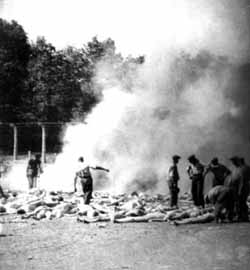
The Jews of Hungary were the last remaining substantial population of European Jewry that had not been murdered by the Nazis. It was the provincial Jews' turn first. Approximately 400,000 of them were sent to the gas chambers of Auschwitz-Birkenau in a matter of weeks in the summer of 1944. There were so many of them that Jews had to "wait their turn" for the gas chambers in a little wood outside of Crematorium V; in their turn, the crematoria could not keep up with the corpses, so many of the bodies were burned in a field behind Crematorium V. The photos of the famous Auschwitz Album, which depict the entire process of extermination in Auschwitz-Birkenau, from the selection on the ramp to the wait outside of the gas chamber, were taken by an SS man in the summer of 1944. The Jews that appear in the photographs are provincial Hungarians. Again, these deportations took place under the aegis of a Hungarian government, and Hungarian gendarmes rounded up the Jews to send them to their deaths.

Horthy, at this point confined to house arrest, ordered a halt to the deportations although several more trains traveled to Auschwitz-Birkenau under Eichmann's supervision. Eichmann was recalled to Berlin, and due to military issues outside of the scope of the present post, future deportations were canceled. 

The Jews of Budapest, while they were to survive in much greater proportions than their provincial brethren, were to suffer horribly. The brutal, fascist, native Arrow Cross party took power in Budapest in October 1944. Jews were confined to ghettos in the city and over 10,000 were forced on foot to Vienna, where they were to build fortifications against the Soviet onslaught. In the meantime, Arrow Cross members shot the Jews in the streets, or forced them to walk, shivering and naked, into the near-frozen Danube River, where they were shot. Their valuables, no need to mention, were taken. Today, not far from the Budapest Parliament building, there is a moving memorial to these dead: life-sized sculptures of shoes, in all sizes, stand silent testament on the banks of the Danube. I remember going to that memorial one evening, staring at the shoes in a kind of numbed disbelief, and at the moving letters that had been left near them by visitors. I walked down a nearby flight of stairs to rocks onto which the waters of the river lapped; a non-smoker, nonetheless I smoked several cigarettes as I contemplated the dark waters of the river. It was, frankly, a lovely sight; Buda Castle atop the hill across the river looked stunning. What this spot had witnessed 70 years earlier was simply not within my ability to imagine.

Suffice it to say, Hungary was no angel in all of this, despite what the ridiculous statue in Budapest would suggest; in fact, quite the opposite. What, however, of Poland?

Poland is a more complex case. First, let me say that the the FBI director erred in uttering the word "Poland" alongside "Germany" and "Hungary." Poland was the first true victim of Hitler's aggression. It was where the Nazis' gloves first really came off. The Poles were detested Slavs. They were to be made eternal slaves to the pure "Aryans" and Heinrich Himmler and Hans Frank, the General Governor with his seat at Wawel in Krakow, decreed that Poles would not be allowed an education beyond being able to write their name and count up to a few hundred. Nothing more was necessary, because they were to serve as no more than mules. Poland did not fight alongside the Nazis; its government fled and set up shop in exile in London. The government established an official underground body, the Home Army, to resist the Nazis. The Home Army was ultimately to lead the Warsaw Uprising of August-October 1944, the largest uprising the Nazis faced in the Second World War. 

Poles, Jew and Gentile, in the western part of the country (the Warthegau) were deported to the central part, the General Government (Hans Frank's domain), which was to become a dumping ground of the "unwanted." Their place was taken by ethnic Germans. Polish children who "looked" German were literally stolen from their parents. In heartrending scenes after the war, these children were sometimes taken from their German "parents": the children, very young, often did not even remember their original parents or how to speak Polish. There was no winning here: either the devastated Polish parents were never to see their precious children again, or the children were to be taken from the only parents they ever knew, to be shipped to a strange country with a strange language. Another horrific crime on the Nazi ledger.

Polish intellectual life was disrupted and the Polish intelligentsia was murdered in the tens of thousands in the initial invasion. 40,000 people were murdered in the initial bombardment of Warsaw. To anticipate events, six million Poles died during the Second World War: three million Gentiles and three million Jews. The Poles suffered very real pain, which has come to dominate that country's national ethos (on top of the rest of the country's anguished history - it has the terrible misfortune of being located between Germany and Russia). 

Polish behavior was often ugly, however - very ugly. Many Poles looked the other way when their Jewish neighbors were deported to Belzec, Sobibor, and Treblinka beginning in spring 1942. Many gladly took their erstwhile neighbors' possessions, including their homes. Indeed, when many surviving Jews returned to their homes, they discovered Polish occupants. Sometimes the Jews were even killed. Jews who tried to hide among Poles, including after revolting and/or escaping from the death camps, were sometimes killed outright or turned over to the Germans for a reward.The local economies around the death camps boomed. The Jews of Poland, but also of other European nations, arrived in their hundreds of thousands to the camps, bringing with them a range of valuables - currency, gold, jewelry, furs, etc. Many of these items found their way into the villages outside of the camps. Ukrainian guards in particular were known to pay for Polish whores, often brought all the way from Warsaw, with absurd amounts of jewelry, gold, or cash. Polish villagers at times sold their own daughters to these guards for the influx of goodies it provided them. After the Nazis destroyed and fled these camps, Polish villagers would descend upon the sites with shovels and pickaxes, digging through skeletons and ashes for valuables. This is not pleasant history, but it happened. Pogroms of Jews occurred after the war, most notoriously in Kielce, in central Poland. In the village of Jedwabne, particularly thuggish, monstrous, and opportunistic Polish villagers locked the Jewish inhabitants into a barn and burned them alive. The Home Army at times expressed savage anti-Semitism. It was skeptical to say the least when the Jews of Warsaw demanded weapons, and gave only a negligible amount, mainly revolvers, to the Jewish fighters. 

There were some extenuating circumstances, at least regarding Polish inaction. The Nazis treated the Poles with a savagery unseen and unknown to the countries of Western Europe. Discovery that you had helped a Jew meant immediate death for you and your family, even if it was just a sip of water or a roll of bread. Some have argued that the Home Army barely had enough weapons for itself to fight the Nazis, let alone to give some of them to the Jews of the Warsaw Ghetto, and elsewhere. It is very easy to sit in a comfortable chair, in a warmed, or air-conditioned, room in the United States of the 21st century and to cast judgment. The Jews of the Judenräte of the ghettos and the Sonderkommandos of the death camps, who deceived the Jews who were to be killed, led them to the gas chambers, removed the bodies, and then burned/buried them have faced similar judgments. But nothing justifies the murder or despicable looting. And overwhelming silence in the face of genocide is very disturbing, to say the least. 

The Poles were no strangers to anti-Semitism, although theirs was of the traditional, Christian variety rather than the racialist, "scientific" anti-Semitism of the Nazis. For many Poles, anti-Semitism was a narrow bridge over which the Nazis could connect. Pre-war hatred of the Jews in Poland was not an isolated phenomenon. There were many Poles of great bravery, kindness, and conviction, such as Irena Sendler, who saved Jews from certain death, but the extent to which the Poles collaborated troubles me. More troubling, actually, is the deafening silence with which the vast majority of Poles greeted the Holocaust. It was not "their" problem; some on the far right of the political spectrum even expressed their approval. Some of the underground literature produced by the Home Army, the underground with the official seal of approval from the government-in-exile, seemed only to care about the Jews' murder insofar as they saw the Poles as next, not about the murder of the Jews in and of itself. 

The problem does not, I don't think, lie with the people of Poland. It lies with the people of Europe as a whole. Many countries, particularly and most importantly Germany, have taken major steps to address the crimes their countrymen committed during the Second World War. Others, especially Hungary, have not. Poland has taken many steps in commemorating the dead of the Holocaust, and many Poles have shown a remarkable admiration of and respect for the memory of the Jews of their country. Major sites of murder such as Auschwitz-Birkenau and Majdanek have been preserved very well. The fact of the matter is that the initiators of the Final Solution were the Germans, but they had their helpers in every country of occupied or Axis Europe. The Holocaust was a continent-wide crime, and a stain on all of Europe. 

What frustrates me is that instead of looking at the broader picture, and at the mass suffering that the war and the Nazis' genocidal policies caused as a whole, there seems to be a contest over who suffered more. The extermination of the Jews is simply in another category: the methodical, thorough nature of the genocide; its continental scope; its factories built specifically and only for the most efficient way to murder the most people possible; the ferocious, unfathomable, and unstoppable nature of the ideology motivating the perpetrators: these are all unique. But the non-Jewish Poles suffered horrifically as well. Their capital of Warsaw was entirely, and purposely, ruined and millions of them were killed. In one particularly devastating instance, in Krakow in July 1943, Germans buried all of the men of a particular parish alive and forced the women to watch on as it happened. The Poles didn't even experience the joy of being liberated in 1944-45; the Soviets moved into the Nazis' place and brutally oppressed the Polish people and suppressed their yearning for independence for an additional 45 years. This is not a contest. Isn't it enough to note that both Jews and non-Jewish Poles were victims of the Nazis? 

This is a deeply concerning, and complex, topic that I hope to explore further. I understand what Comey was saying. There was indeed disturbing collaboration among Poles. I do believe, however, that it was a mistake to mention Poland in the same company as Germany and Hungary, two outright perpetrating nations and governments. Poland happens to be the site of the Nazi death camps and therefore is often thought of, in an overly simplistic fashion, as somehow a perpetrator via osmosis. The haunting image of the gatehouse at Auschwitz-Birkenau is seared into all of our consciences, and it happens to lie in Poland. Suffice to say that the picture of wartime Poland is a very complex one, with darkness and light - I'd argue mostly darkness. But where in continental Europe did darkness not rule the skies? 

Tuesday, January 27, 2015

Auschwitz: A Brief History and Reflection

Today marks the 70th anniversary of the liberation of Auschwitz-Birkenau. Located in southern Poland, some 40 miles west of the cultural center of Krakow, 1.1 million people were murdered there. Birkenau, the death camp, is a haunting, vast space where you can smell vague wafts of burning (fittingly enough) and where, at least in the back, you can convince yourself that you're taking a stroll in some pleasant park. From the rear of the camp, the infamous gatehouse is barely visible - it nearly vanishes into the horizon. Rows upon rows of the ruins of barracks line your vision. If you go at dusk (or dawn, I presume), it's quiet and disturbing. If you go at more regular hours, expect hordes of tourists, at least at the ramp and the crematoria ruins.

The main camp, the Stammlager, also known as Auschwitz I, lies some 2 plus miles down the road. If one didn't know any better, it could almost be a college campus. There are neat, orderly rows of brick buildings. Today they house a variety of exhibits (including mountains of human hair, suitcases, children's clothing, shoes) as well as the administrative offices of the museum. This was the first concentration camp established by the Nazis in Poland, in 1940 (although, at the time, it was technically annexed to the Reich and not part of Nazi-occupied Poland, otherwise known as the General Government). This is the location of the Arbeit Macht Frei gate, which many inaccurately believe was one of the last sights many of the Jews of Europe saw before they were murdered. This is not so. The vast majority of the Jews were killed down the road, in Birkenau, and never saw the Arbeit Macht Frei gate. Unfortunately, I don't think the museum does the best job in the world of differentiating between the two camps.

What was the origin of the camp? The Stammlager, which was the site of an unused army base, was established to concentrate Polish labor. The Nazis, having annexed Upper Silesia (the region in which Auschwitz is located) wanted to simply deport all of the Poles and move ethnic Germans in. However, they soon realized that they would need the Poles for their skilled manual labor. In order to imprison these Poles should they become rowdy, a camp was necessary: this would be Auschwitz. Auschwitz was deadly for non-Jewish Poles: some 80,000 died there. It became a watchword of terror among the Poles. But it had not yet attained its fully notorious status.

I must briefly rewind and dive a bit into Nazi Lebensraumpolitik. I hinted at it in the previous paragraph. The Nazis wanted Poland and the Soviet territories of the time for Lebensraum (living space). In order to have the space, the Poles and the Jews were to be kicked out of their homes. It was the intention of Heinrich Himmler, in his capacity as head of the SS and Reich Commissioner for the Strengthening of Germandom, to establish a series of fortress-cities in which SS warrior-farmers would reside to till the soil and, if need be, fight the "hordes" of the East. Auschwitz (Oswiecim in Polish) was to be one such site. An entire SS city was planned. This also combined with two other important factors: Himmler's agricultural obsessions and German war industry. Himmler wanted the land around Auschwitz as a "Zone of Interest", to be completely controlled by the SS for experimental agricultural purposes. German industry, specifically the chemicals firm I.G. Farben, also expressed interest in the site, and a deal was struck between industry and the SS. An I.G. Farben plant, which was to produce Buna (synthetic rubber) for the war effort, was established in nearby Monowice.

In the meantime, Himmler ordered that Soviet prisoners of war were to work the agricultural and industrial areas in and around Auschwitz. He ordered the creation of a huge POW camp at a Polish village called Brzezinka, known to history as Birkenau. However, while the POWs were indeed sent to Birkenau, there were not enough of them, as the German army was systematically starving them on the Eastern Front (over three million Soviet POWs were killed, either summarily or by starvation, during the war). Someone needed to man the new camp built at Birkenau. Himmler decided that they would be Jews. In addition to the industry and agriculture, they would be set to work on the ideal SS-town which Auschwitz was meant to become. When Hitler's Operation Typhoon stalled before Moscow, and the German offensive with it (at least for the winter of 1941-42), Himmler's dream of deporting the Jews somewhere to the East died with it. So did his dream of the SS-town of Auschwitz. He lost interest. Auschwitz-Birkenau was to become the dumping ground of Jews and, eventually (although Himmler could not have foreseen it himself), the graveyard of European Jewry.

Two peasant cottages at the back of Birkenau were converted into provisional gas chambers. Jews from Upper Silesia and Slovakia became its victims. As the brief for the camp widened, huge crematoria/gas chambers (Crematoria II-V) were constructed. The Jews of the Reich (including what is now Austria and the Czech Republic), Slovakia, Upper Silesia, and France were the first victims. Most Polish Jews were actually murdered further east, in the camps of Belzec, Sobibor, and Treblinka. When the Final Solution exploded into its final iteration, and was fed by a systematized operation of trains that covered the breadth of Europe, Auschwitz was ideally located. The Jews of Greece, Italy, and Yugoslavia were sent there. In 1944, there was only one last major population of Jews remaining: in Hungary. After the German occupation of Hungary, in March 1944, Adolf Eichmann swept into Budapest and orchestrated the mass deportation of the Jews of provincial Hungary. Some 400,000 were murdered in several weeks in the summer of 1944. It is Hungarian Jews that can be seen in the notorious Auschwitz Album, which shows Jews arriving in Birkenau, being unloaded from the trains, selected either for a brief, miserable life or death, and marched to the gas chambers, and finally awaiting their deaths right outside of the death houses themselves. (Also, conversely, one can see the Höcker Album, which shows SS officers, including Auschwitz commandant Rudolf Höss and camp doctor Josef Mengele, at exactly the same historical moment, enjoying themselves at a resort not far from the camp). So many Jews were sent to Birkenau in the summer of 1944 that the crematoria could not keep up, and bodies had to be burned in an open field behind Crematorium V.

The Jews at Auschwitz-Birkenau were liberated by the Soviet Army on January 27, 1945, the date that later became Holocaust Memorial Day. As this 70th anniversary is commemorated, it behooves us to briefly reflect upon the context and sordid history of the place.

Thursday, December 11, 2014

Assessing Adolf Hitler

I finally got around to reading Explaining Hitler by Ron Rosenbaum, a journalist, essayist, and novelist. I had ignorantly neglected it on the shelves for several years; I thought, wrongly, that it was a psychobabble assessment of Adolf Hitler that "explained" the anti-Semitic, war-making monster Hitler became later in life. In fact, the book is less an analysis of Hitler than an analysis of the various explanations that have been put forward to explain the Nazi dictator. The result is profoundly disturbing and important.

These analyses of Hitler range from the ridiculous to the plausible: his aggression can be explained by the overweening love of his mother and his lack of a testicle, or because of an abusive father; his anti-Semitism can be explained because he contracted syphilis from a Jewish whore, or because his grandmother had served as a maid in a Jewish household that paid for Hitler's father's upbringing - had his grandmother been impregnated by the 19-year-old son of the family? Hitler was extinguishing the Jew in himself by annihilating the Jews of Europe, this explanation suggests. Hitler's mother died of cancer in 1907 under the care of a Jewish physician, Dr. Eduard Bloch; perhaps Hitler wanted to kill all of the Jews for this reason? Some suggest that Hitler's abnormal presence in history and geopolitics can be explained due to sexual perversions, such as (undocumented except by hearsay) coprophilia and undinism. What of Geli Raubal, Hitler's half-niece upon whom he was fixated? Hermann Göring, the second-ranking man in Nazi Germany, said that after her death (ruled a suicide) in 1931, Hitler changed. Yes, he had never been a humanitarian, but after her death he shut off all human feeling. This is eerily similar to the mysterious suicide of Stalin's wife Nadezhda Alliluyeva, who died a year after Raubal; Stalin too was said to have shut off all remaining humanness he may have had after this incident. Did Raubal commit suicide because of Hitler's perversions, because of something abnormal about him? Did Hitler have her killed? These are interesting questions but the disproportionate emphasis placed on them by psychoanalysts and psychohistorians is absurd. The skeptical Rosenbaum, while wading in these theories and explaining them in detail, is similarly unconvinced.

Rosenbaum also dives into, in my opinion, more serious attempts to understand Hitler: was he convinced of his own rectitude, as per the historian Hugh Trevor-Roper, or was he an actor who eventually became convinced of his own role, as per the historian Alan Bullock? Does Hitler represent an "eruption of demonism into history", as posited by theologian Emil Fackenheim, or was the Holocaust caused by German "eliminationist anti-Semitism" as per political scientist Daniel Jonah Goldhagen, whose thesis significantly minimizes Hitler's role in the Holocaust? Can we believe in a loving God, or God at all, in light of the Holocaust? When did Hitler decide to kill the Jews? Was it in November 1918, when he heard of the German capitulation while recovering from a gas attack at the military hospital in Pasewalk (as per historian Lucy Dawidowicz) or was it at some point in 1941, in reaction to either a) the initial victories in the Soviet Union or b) the setbacks in the Soviet Union that winter (there is no historical consensus, and this is a matter for enormous debate, but most historians place the decision to murder the Jews at some point in 1941, not decades beforehand). 

The inability to "diagnose" Hitler is disturbing. Few people have had more ink spilled about them. Much attention has been paid to Hitler not only by scholars, but by novelists, filmmakers, philosophers, theologians, and the public at large. Hitler sells. Yet it seems we cannot begin to understand him. The range of arguments about what made Hitler Hitler, what made him commit his monstrous deeds, is a very telling indicator of this fact. The ratio of words written about and the attention paid to Hitler to the actual understanding of what made Hitler tick is astronomical. Indeed, some, most prominently the filmmaker Claude Lanzmann, argue strenuously that even attempting to understand Hitler is to exculpate him from his crimes. 

Lanzmann, absurdly, suggests that to try to understand Hitler or the Nazis is akin to Holocaust denial. He credits this stance to Primo Levi. Levi, the author of many important books and a survivor of Auschwitz, wrote a passage in his book Survival in Auschwitz that, raving from thirst upon his arrival in the camp, he grabbed an icicle dangling from a barrack. Before he could put it in his mouth, it was ripped from him by an SS guard. Levi, distraught, pleaded, "Why?" and the SS man responded, "Hier ist kein warum" (here there is no why). Lanzmann takes this cynical statement by a brutal SS man and proceeds to make it his worldview on how to approach studying and analyzing the Holocaust and the Nazis. Perhaps there is no why in a grotesque place like Auschwitz, but to silence the attempt to even ask the question (as Lanzmann has done, publicly and aggressively) is, ironically, totalitarian.

I have been reading about Hitler, the Nazis, and the Holocaust for as long as I can remember. I can rattle off the hows, the whats, the wheres, the whens, and the who's. As disturbing as this all is, it is the whys that has kept me up nights. It is an eternal question that can never be answered, and for that reason is profoundly disturbing. Yes, we know that SS men clambered onto the short roofs of Birkenau's crematoria and poured in pellets of Zyklon B; we know the mechanisms of how Zyklon B entered the chamber and how the system of introduction was designed to make the killing more efficient; we know where this happened; we know when it happened; we know the identities of the men who poured the pellets, of the men who lied to the Jews and told them they were just being deloused, of the men who ran the camps and the entire extermination program. But why? The Jews represented no economic, political, or military danger to Germany. Yet they were hunted mercilessly in the cities, the villages, and the forests of Europe, so that every last one of them could be murdered. Heinrich Himmler made it a priority to visit Finland and ask that government to turn over the 200 Finnish Jews to be "resettled." This was, clearly, an ideological fear and hatred writ large. There was simply no economic, political, or military justification for demanding the deportation of these 200 Finnish Jews; they were to be murdered because they were Jews. This is chilling. This is something that I can never, and will never, understand. 

This differentiates the Nazis' genocidal onslaught from previous or subsequent genocides. The Nazis did, in a sense, believe the Jews to be a fifth column because they were obsessed with the (false) memories of the last days of the First World War: how the Jews had, in their eyes, stabbed the German Army in the back and thus forfeited German honor. This was not to happen again. However, the universalization of this notion, absurd to begin with, to include men, women, and children from the entire European continent and the relentless determination to murder them all, unless if they were temporarily useful for the German war effort: this is unique. Jewish men were considered a Bolshevik menace; they had to be killed. If their women were left alive, they would not be able to provide for themselves, and would be a headache to the Nazi state; they had to be killed. The children could not be separated from their mothers in a "tidy" fashion, and in the future they would represent the avengers of their parents; they, too, had to be killed. 

I have been ruminating over the nature of Hitler for the last several days, and I find myself not knowing what to believe. I do not know if he was a convinced anti-Semite from his bohemian days in Vienna, or if he became one once immersed in the postwar chaos of Munich. I do not know if he foresaw the extermination of the Jews from his younger days or not. I do not know why he thought what he thought, which remained remarkably consistent from 1919 Munich, through Mein Kampf (composed in 1924), through the Machtergreifung of 1933, the beginning of the Second World War in 1939, the beginning of the wholesale murder of Jews in the summer of 1941, all the way to his suicide in the otherworldly Führerbunker in April 1945. I do not know if Hitler was a raving lunatic in his private life, as he was in his harangues in the Nuremberg rallies, or if this was just an act, and he shed his skin upon returning to his private quarters (I lean toward a fusion of the two, which is cheating, I know). 

Even how one analyzes the Holocaust is inseparable from how one analyzes Hitler. Did Hitler always intend a Holocaust, although not necessarily the one that occurred? Or did he just want the Jews "out" but had to improvise due to wartime contingencies? Did the Holocaust come from top-down orders (i.e., Hitler to Himmler/Heydrich to Eichmann downward) or was it the culmination of organic, grassroots processes to "solve" the "Jewish question"? Historians argue vociferously about what time in 1941 the go-ahead for the extermination of the Jews was given, as mentioned above. This also reflects one's view of Hitler. Was it before the invasion of the Soviet Union and inseparable from that ideological conflict? To follow up from this: Did Hitler make the decision due to the euphoria that came with the victories in the early stages of the invasion? Did the decision come when the Nazis failed to take Moscow and Leningrad, and then did not know what else to do with the Jews that they had cooped up in the ghettos of Poland, other than murder them? This last theory makes Hitler and the Nazis much less ideological in their pursuit of exterminating the Jews and more "pragmatic": there was not enough food to go around, and there was the danger of disease, so the Jews needed to be killed. Or did the decision come in December 1941, after the Pearl Harbor attack, after the war truly became global in scope? Because in January 1939, Hitler had made a "prophecy" that in the event of a world war, the result would not be the victory of international Jewry ("and therefore the Bolshevization of  the earth") but the destruction of the European Jews. Was it time now to make this prophecy a reality? 

Again, I take the Goldilocks position. I believe that Hitler was necessary for the Holocaust to have happened, and that not just anyone in his position would have done the same(to take the title of the 1984 Milton Himmelfarb essay in Commentary, "No Hitler, No Holocaust"). Would a Nazi Germany headed by Hermann Göring have embarked on what became the Holocaust? Obviously, I don't know, but I don't think so. Hitler's ideology and hatred suffused the Nazi leadership as well as the middlemen in the bureaucracy and lower-ranking individuals of the SS, the army, and the police. It gave them the general parameters in which to work. However, unlike the popular conception of the Nazi regime as streamlined and centralized, it was rather decentralized and chaotic. Hitler, the Social Darwinist who was obsessed with "survival of the fittest", made his regime a jungle in which his ministers were constantly fighting for his favor. Rosenberg clashed with Goebbels, Himmler with Göring, Bormann with everyone; the SS was pitted against the civilian bureaucracy and the army; within the SS, the Wirtschafts-Verwaltungshauptamt (WVHA, or Economic and Administration Office) and the Reichssicherheitshauptamt (RSHA, or Reich Main Security Office) clashed for influence; and so on. In the words of historian and Hitler biographer Ian Kershaw, Nazi officials "worked toward the Führer": they had an idea of what he wanted and they took the initiative to act upon it. Those who put forward the idea closest to Hitler's heart (usually the most radical of initiatives) were successful: Himmler and Heydrich were particularly successful in this arena. So, the Holocaust was the fusion of a top-down, Hitler-driven, ideological approach and a bottom-up, proactive, sycophantic approach. While historians have been biting each others' heads off about these issues since the Historikerstreit ("historians' quarrel") of the 1970s, they are not, in my opinion, mutually exclusive. I am not persuaded by the arguments of the exclusively intentionalist ("Hitler always intended to exterminate the Jews") or the exclusively functionalist ("The Holocaust was the product of initiatives by middle-ranking bureaucrats largely driven by self-interest"). 

Where do I place Hitler? Was he dithering, hesitant in giving the green light to the Final Solution? Was he a laughing maniac who delighted in the annihilation of the Jews, as concluded by Rosenbaum? Somewhere in between? Somewhere else? I don't know. That is the insane thing about Hitler. As I wrote before, for as much as has been written about him, he is a mystery. The more I read about him, the less I know or understand about him. Should I even bother understanding him? The attempt is challenging and very, very disturbing. What does Hitler say about the capacity of humans to do evil? Or was he beyond the range of human capacity, off the charts, standards of deviations away from even the Jeffrey Dahmers and Ted Bundys of the world? The last is the view of the theologian Emil Fackenheim, and I have to disagree. As profoundly disturbing as it is to contemplate, Hitler was human, just as human as you and me. But that is not enlightening in and of itself. Okay, great, he was human. So what? The more interesting questions are: Why? Why did he embark on such destruction? And what was his motivation? He was anti-Semitic, sure, but there are lots of anti-Semites. There was only one Hitler. 

This post consisted of a lot of questions. But that is indicative of the matter at hand. For all that is written about Adolf Hitler, I still think there are more questions than answers.